TikTok Shop vs Amazon FBA: Which Platform Is Right for You?
 Updated on August 26, 2026

Choosing between TikTok Shop and Amazon FBA is one of the more consequential decisions you can make as an e-commerce seller right now. Both platforms generate real revenue, but they do it in fundamentally different ways, and what works well on one can fall flat on the other.
TikTok Shop runs on social commerce, where discovery and impulse drive purchases. Amazon FBA runs on search intent, where buyers already know what they want. Your product type, audience, and business goals determine which model fits you better. This guide walks through both platforms so you can make a clear, informed decision.
TikTok Shop vs Amazon FBA at a Glance
Choosing between TikTok Shop and Amazon FBA comes down to five key factors. Here is a quick framework to guide your decision:
- Identify your buyer and where they already shop online
- Compare platform fees and fulfillment costs for your product category
- Evaluate profit margins under each model before committing
- Consider exit potential and long-term defensibility of each platform
- Decide on a hybrid selling approach or commit fully to one channel
Work through each step in order. The sections below cover all five in detail.
Before You Begin: Know What Each Platform Expects
The two platforms have different entry requirements, and skipping this step leads to costly surprises later.
To sell on Amazon FBA, you need:
- An Amazon Seller Central account
- UPC codes for each product
- A supplier or sourcing process in place
- Capital to purchase inventory upfront and ship it to Amazon warehouses
Reviewing how the FBA model works before you commit helps you plan your cash flow and inventory cycles accurately.
To sell on TikTok Shop, you need:
- A TikTok for Business account
- Content creation capability, or relationships with affiliate creators who can promote your products
- A fulfillment method: either self-fulfillment or Fulfilled by TikTok (FBT)
Selling through TikTok Shop also requires a faster content cadence than most sellers expect.
Both platforms have different onboarding timelines and capital requirements, so knowing your starting position matters before you compare them directly and start your due diligence.
Compare Fees, Fulfillment, and Profit Margins Side by Side
The financial mechanics of each platform vary more than most sellers realize at first glance. Before you can make a confident decision, you need to look at both fee structures and realistic margin outcomes side by side.
Break Down Referral and Fulfillment Fees
Fee structure is where the two platforms diverge most clearly.
TikTok Shop charges a flat official referral fee of 6% per order as of April 2024. Amazon’s referral fees range from 8% to 15% depending on your product category, and that is before fulfillment costs enter the picture.
Amazon FBA adds per-unit fulfillment fees on top of referral fees, plus monthly storage charges. Fulfilled by TikTok (FBT) is still maturing, but its fulfillment costs tend to run lower for lightweight, high-volume products.
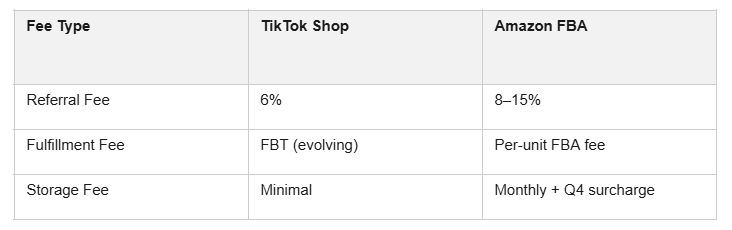
Note: Amazon FBA storage fees spike significantly during Q4. If your inventory sits unsold through October to December, those surcharges can compress margins faster than most sellers anticipate. Plan your inventory levels carefully before peak season.
Calculate Realistic Profit Margins on Each Platform
Lower referral fees do not automatically mean higher margins. You need to factor in your average order value (AOV), Amazon PPC spend, and returns handling.
Amazon PPC costs have risen steadily in competitive categories, eating into margins even when your referral and fulfillment fees look manageable. TikTok Shop shifts that cost toward content production and creator affiliate commissions instead.
Returns on Amazon FBA are operationally smooth but carry real costs. TikTok Shop returns remain inconsistent, which creates unpredictable post-sale expenses.
Evaluate Audience Reach and Customer Acquisition Costs
Amazon commands roughly 40% of U.S. e-commerce market share, which means your products sit in front of buyers who are already searching with intent. The Prime badge reinforces that trust and drives repeat purchases in a way TikTok currently cannot match.
TikTok Shop works differently. Discovery happens through content, affiliate creators, and livestream shopping, not search. That model skews heavily toward Gen Z and impulse-driven buying, which suits certain product categories well but creates weaker repeat-purchase behavior overall.
Customer acquisition cost tells the real story here. Amazon PPC competition has pushed costs up steadily in most categories, compressing margins even when your fees look reasonable. TikTok’s organic reach still offers a lower customer acquisition cost for brands that can produce consistent, engaging content without relying entirely on paid promotion.
Your CAC on each platform depends on how well your product fits the buying behavior that platform rewards.
Assess Long-Term Defensibility and Exit Value
Amazon FBA has a well-established track record as an acquirable asset. Buyers understand the model, revenue is predictable, and multiples are relatively consistent across categories. When you sell an FBA business, the value transfers cleanly because it is built on systems, supplier relationships, and search rankings rather than personality. Shopify is much the same when compared to TikTok Shop.
TikTok Shop businesses are harder to value at exit. Revenue tied to creator relationships or a specific account’s following does not transfer easily to a new owner, and buyers discount that risk, which compresses multiples. Keep this in mind when preparing your TikTok Shop business for an exit.
A hybrid selling approach changes this picture. When your revenue is distributed across both platforms, you reduce dependence on any single channel. That diversification makes your business more defensible and typically supports a higher valuation multiple at exit.
If you are building toward a sale, put together an acquisition checklist and think carefully about how much of your revenue a buyer could realistically maintain without you involved. Transferable systems and diversified traffic sources drive acquisition value, regardless of which platform generates more revenue today.
Avoid These Common Mistakes on Both Platforms
Watch out for these mistakes before you commit to either platform.
Launching on TikTok Shop without a content plan or established affiliate creators is one of the fastest ways to generate zero sales. The platform does not surface products through search, so without content driving traffic to your listings, your products simply sit there.
On Amazon FBA, new sellers consistently underestimate storage fees and returns costs. Those charges compound quickly, especially if inventory moves slower than projected.
Two other mistakes worth avoiding: treating TikTok Shop like a traditional marketplace instead of a content-driven channel, and jumping into Amazon PPC before your listings are fully optimized. Both errors burn budget without building traction.
Frequently Asked Questions
Is TikTok Shop Worth It for Sellers?
TikTok Shop is worth it if you sell impulse-buy products and have access to content creators or strong in-house video production. It works especially well for brands targeting Gen Z buyers. If your product needs search-driven discovery, Amazon FBA is likely a better fit.
How Much Does Amazon Take from a $100 Sale?
When you combine referral fees, fulfillment fees, and typical Amazon PPC spend, Amazon takes roughly $30 to $45 from a $100 sale depending on your category and ad costs. That range can shift further if storage fees or returns are factored in.
Do People Actually Make Money on TikTok Shop?
Yes, sellers do make money on TikTok Shop, but results depend heavily on content virality and affiliate partnerships. Without consistent creator-driven traffic, most listings generate little to no sales.
How Do TikTok Shop and Amazon FBA Businesses Compare as Acquirable Assets?
Amazon FBA businesses have clearer valuation frameworks and a longer track record with buyers. TikTok Shop businesses are emerging as acquirable assets but are harder to value when revenue ties closely to a specific account or creator relationship.
Pick Your Platform and Start Selling
The right choice between TikTok Shop and Amazon FBA depends on your product type, your strengths as a seller, and where you want the business to be in three to five years. Neither platform wins outright for every seller.
If you can run both, a hybrid selling strategy reduces channel risk and builds a more defensible business at exit. Start where your product fits best, then expand from there.