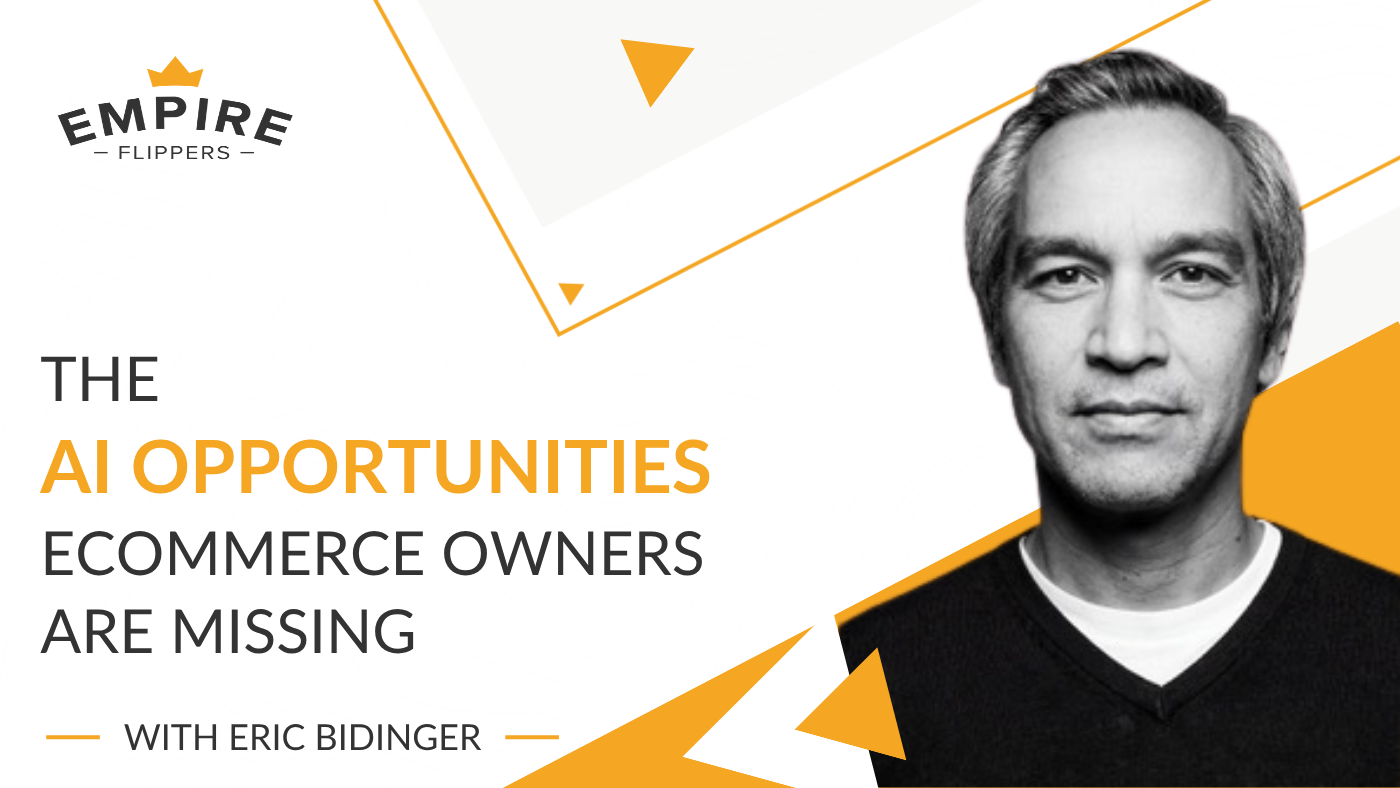
The AI Opportunities Ecommerce Owners Are Missing With Eric Bidinger [Ep.223]
 September 29, 2026
 AI can write your product descriptions, generate ad creative, and answer customer questions. But those might not be the most valuable uses of AI for ecommerce.
In this episode, we sit down with Eric Bidinger, co-founder and CEO of Luca AI, a tool that uses AI to analyze business data and help entrepreneurs identify opportunities to improve their businesses. We explore where AI is actually making a difference for online businesses and where the hype is getting ahead of reality.
One of the biggest opportunities is hidden inside the less exciting parts of running a business.
The goal isn’t simply to use AI to generate more data. It’s to turn that data into better decisions. AI can analyze huge amounts of business data to uncover operational inefficiencies, pricing opportunities, inventory problems, and other areas where money is being left on the table.
We also discuss how AI could change the way ecommerce businesses think about growth capital, why smaller operational improvements can have a major impact on profitability, and what entrepreneurs should be paying attention to as AI continues to evolve.
If you’re looking for new ways to unlock growth or simply want to optimize your business, this episode is packed with useful information.
Topics discussed in this episode:
-
02:32 – The origins of Luca AI and what the software does
-
06:55 – Where AI is useful vs. where it’s still hype
-
11:41 – Using AI for the less obvious parts of ecommerce
-
18:41 – Debt, equity, and other ways to finance growth
-
21:25 – How AI can identify opportunities you aren’t looking for
-
31:29 – The problem with AI hallucinations and business data
-
38:25 – How technical do modern founders need to be?
-
40:41 – How to balance AI data with out-of-the-box thinking
-
43:28 – Creating a competitive advantage when everyone has AI
Mentions:
Sit back, grab a coffee, and learn how to optimize and grow your business using AI.
Listen to this episode



Transcript
Welcome to the Opportunity Podcast, where entrepreneurs come to learn from real buyers, sellers, and industry experts about lesser-known growth opportunities to build their online business empires.
We'll uncover tactics veteran online business entrepreneurs have used to build, buy, flip, and sell their way toward personal wealth. Sit back, grab a coffee, and get ready to uncover hidden growth secrets. The Opportunity Podcast starts now.
Welcome to another episode of the Opportunity Podcast. I'm your host, Greg Elfrink, the head of marketing over here at Empire Flippers. Today, I am speaking with Eric Brodinger of Ask Luca, or Luca Escrow—I think the URL is. It'll be in the show notes.
This was a super interesting conversation. Eric is a former aerospace engineer who went into the finance world, started his own DTC brand, and now is creating a pretty comprehensive AI tool for DTC commerce owners.
We have a very wide-ranging conversation here because Luca doesn't just do one thing; it does a ton of things. It works by utilizing your own data to start asking you questions about what you want, creating reports about what you should be doing, and incrementally giving you way more profit.
I've often said—I think I even say it in this episode—that so much of success in e-commerce is just victory by a thousand cuts. You know the old saying, “death by a thousand cuts”? Little tiny wins at scale can do wonders for your margin, which, of course, means your business will be more profitable.
When you come to me at Empire Flippers, we can sell you for a much higher price down the road. Or, if you buy a business from us, you can use something like Luca to grow that profit, come back, and flip it with us.
But anyways, I'll get off my soapbox here. I really enjoyed this conversation with Eric. He's an incredibly smart guy, and I think you guys should check out this tool. If you're in the DTC world, it's worth taking a look at Luca AI.
All right, enough said. We'll get into the show, and I'll see you on the other side.
All right, I have Eric Brodinger with me from Ask Luca. We had an incredibly pleasant conversation offline before we started recording. But for everyone who doesn't know who you are and what Ask Luca is, give me a pitch about where you are in the world and what Ask Luca is doing for e-commerce entrepreneurs.
Thank you, Greg. Thanks for having me on. I'm Eric, the co-founder and CEO of—we call it Luca AI. The website is Ask Luca, but that's because we don't have enough money to buy ourselves the Luca.com real estate.
What we do there is very simple. We work on the premise that AI is extremely good when it's unleashed on a lot of proprietary data. We haven't found any more data-rich environment than e-commerce, especially at their level of development.
What we do at Ask Luca is allow our clients to deploy frontier models on their company's data in a way that's safe, secure, and private, to the same extent that every large enterprise in the world is doing today, whether you're JPMorgan or United Airlines.
Except that the big guys have big capabilities and massive budgets, and the small guys don't. That's where we come in with a turnkey solution that abstracts away all the complexity of the implementation phase.
I'll just finish up with one small comment here, which is interesting because I think it's the revolution that we're going through at the moment. The AI revolution is probably the only time in history when what powers the revolution itself—the intelligence in a bottle—is 100% commoditized.
It doesn't matter whether you're United Airlines or Bob the Baker down the street. You have access to Claude 5, Astra, and GPT-6. The intelligence itself is available to everyone. How to roll it out and implement it so that you can make use of it in a way that's beneficial to your business—that's where the secret sauce is.
We're going to get deep into the secret sauce, but before we do that, talk to me a little bit about how Ask Luca became a thing. What were you doing before, and what was the inspiration for this idea?
My background is engineering. I'm an aerospace engineer and applied mathematician. My co-founder has also followed the same trajectory in that he's an applied mathematician by training. But then we both lost our way and ended up in finance—for myself, 17 years, and for him, close to 15 years in private equity.
Then our paths crossed when we decided that finance was not for us, for a variety of reasons. We both wanted to build something tangible and useful, as opposed to just collecting a fee when money moves from pocket A to pocket B.
The genesis story of Luca—I'm just going to keep it very short—is that I created a DTC brand during the pandemic, which failed. It failed for many reasons, but during the postmortem analysis of what I could have done differently, I started thinking about the tool. I was essentially conceptualizing in my head what Luca is today.
The technology wasn't quite ready at the time. But when the first reasoning models came out—GPT-1O, I think, circa early 2024—you started to see the inkling of what was possible. You could definitely hook these things up to a bunch of data.
Instead of having a financial analyst, a data analyst, a data scientist, and a research analyst, the AIs were starting to become good enough that, if you plugged the systems into your proprietary data and gave them the right context, you would have the blueprint of something that could be extremely useful to help you run a business better.
So that's the origin story.
That's awesome. I actually had another aerospace engineer on this podcast. It was super random. He used the technology that was sent into outer space with NASA to create a DTC brand in the beauty and cosmetics niche, which I found fascinating. So you're in good company as an aerospace engineer.
Let's move into the AI stuff. My first question for you is a pretty broad one, but I've been inundated with AI stuff—both the good and the bad. I feel that it's, at once, the most overhyped technology and, at the same time, the most underrated technology. I don't know if you feel the same, but talk to me about where that hype is probably still hype in the e-commerce world and where it's really, really good now.
Very good question, and I 100% agree with you. What's the term people are using? “Jagged intelligence,” right? It's incredibly good in some areas and incredibly dumb, if you want to call it that, in others.
I think what's interesting is that AI is most useful in the non-obvious areas. It's where things are ugly, unglamorous, and incredibly tedious.
What I mean by that is that AI is incredibly useful if it has access to data—or, call it a data lakehouse—that's incredibly well ordered, where the schemas are properly labeled, where you have the proper descriptions of what the data is and what the data means, and especially where you have a reconciliation of what those definitions are across the various functional areas of a business.
You let AI loose on that, and it's going to be incredibly good at finding hidden patterns that are invisible to the human eye. We simply can't process that much data or build a coherent picture because of its richness. AI is incredibly good at building a very coherent picture of the business at a level of abstraction that we humans will never be able to.
In that non-sexy, doesn't-necessarily-wow-you-during-a-demo—but very useful, actionable, and insightful—area, AI can show you what you're missing. What are the hidden pockets of growth that you're currently overlooking? What are the low-hanging fruits that you've missed? What are the hidden pockets of operational efficiency in the way you do things?
Generally speaking, all of this is contained in your company's data. AI is very good at doing this.
On the hype side, there's no shortage of it. We're being sold—or perhaps we're also a little bit guilty of selling—gigantic capabilities where, as a founder or brand operator, you press a button and suddenly the thing goes out and does a bunch of things with a super-long time horizon while maintaining coherence.
We're not there yet. We might be at some point, and that would be amazing because it would literally mean that you could put your business, or at least parts of your business, on autopilot. I hope we get there, but certainly that's super hyped at the moment.
Anything that has to do with using AI as a growth channel, content generation, and all of that—I mean, it's good, but I don't think it's quite there yet.
Anything that's customer-service-related—the interface between your brand and your customers—we've seen some people outsource this to AI with mixed results. Sometimes it's good, sometimes it's not. The problem is that with your customers, you can't really afford to be inconsistent. It needs to be on point every time.
Yeah, I agree. The thing I was going to say on the content side is that my background is content marketing. That's where I cut my teeth in the marketing world. I have a lot of friends who are thought leaders, posting blogs, LinkedIn posts, and that kind of stuff that I used to follow.
Ever since the advent of AI, I've ironically lessened my social media addiction because all my friends have become ChatGPT rappers. I could just tell they were prompting it differently, but it sounded exactly the same.
I was talking to one of my coworkers who wants to start posting more on LinkedIn. He kept showing me LinkedIn posts “in the style of” Sam Parr or other great content marketers. I said, “Dude, this just sounds like ChatGPT.”
“Yeah, but I prompted it differently.”
“But it sounds exactly the same.”
That's the point. You can try it, and sometimes it works. I did notice that, in short bursts, it can do pretty well. I deepfaked myself when I was running behind on some YouTube videos. I wondered if I could create a deepfake of myself for a 30-second short. That did okay because it was just long enough that you couldn't see the uncanny valley.
But I agree with you on all that stuff. When it comes to e-commerce, you can tell me if I'm wrong here, but I feel like some of the most useful things are a lot of the hidden stuff—inventory management, for example.
We have a lot of businesses that stock out, and it really hurts their ability to sell the business and, obviously, to sell more products. What are all these behind-the-scenes things that AI is doing—the tactical stuff?
Stockouts are a no-go. If you're still suffering from this in this day and age, I'm sorry—I don't mean to be provocative—but why are you concerned about it? It's really shooting yourself in the foot. You should never be in that position.
But yes, that's a great use case. You have use cases rooted in data where you can augment human decisions—the leadership team—with data-driven, evidence-based decision-making. The AI is very good at that, and you can apply it to many different use cases.
Inventory management is definitely one of them. Based on sales velocity, you should always have your inventory properly stocked. You can do some predictive analytics, but everything is a question of trade-offs. There's no right or wrong answer; there's only where you want to put the cursor on the trade-off.
You want to make sure your inventory is properly stocked, but at the same time, you don't want to trap too much capital in your inventory. There's an optimal point where your inventory should be, and that optimal point changes throughout the year because of seasonality. You need to stay on that edge all the time because that's what allows you to release capital to do other things.
I think anything related to calculating your margin truth is important. Forget about vanity metrics and one-dimensional KPIs. Ultimately, what's the impact on the bottom line? What's the real operating contribution margin of certain product lines or SKUs when you take into account refunds, discounts, returns, postage fees, and all of that?
Ultimately, when you reconcile all of those elements to the cash in the bank, that's what matters. At the end of the day, how much cash have you generated during that period based on all the economic activity you've undertaken upstream?
Those kinds of use cases around product optimization, pricing optimization, liquidity management, and various what-if scenarios are super important. You need to run them on both the upside and the downside. You need to be able to harden your business against external shocks that are beyond your control, whether they're macro shocks or diesel at $6 a gallon when you hadn't planned for it in January.
All of those things are areas where AI is actually very good. Again, it's not the bells and whistles of your OpenClaw or Hermes tool, where you press a button and it goes out to augment an entire list of potential clients, calls those people, and suddenly you have meetings in your diary.
It's the bread-and-butter, nitty-gritty work of actually running a business properly and focusing on what matters: the bottom line and cash generation.
So, in your view, is the most useful thing here finance forecasting? E-commerce accounting can be pretty complex. In our experience, every time an e-commerce seller comes to us, we almost always rebuild their P&L. Especially if they're a smaller business—say, less than $2 million in valuation—their books are often a complete mess, so we have to rebuild them.
Sometimes they realize, “Oh, I’m not making nearly as much money as I thought I was.” It sounds like, from your perspective, this kind of financial forecasting is the most useful thing to plug AI into with all your data. Is that what I'm hearing?
Yes, I'll go beyond that. Everything eventually subsumes itself under financial forecasting. Whatever it is that you do—whether it's a Meta campaign or product-development ideas around your SKUs—it ultimately comes down to what impact it's going to have on your bottom line.
I'm sorry; it sounds trite, but—
No, it's not. It's a fundamental reality of business.
Exactly. It's a fundamental reality of business, and I think a lot of people forget that. They get lost in a bunch of things that are important but ultimately peripheral to the central question: How do I grow my bottom line?
I'm a creative guy, so spreadsheets and I are arch enemies. As a marketer, I tell people all the time that they should keep an EBITDA tracker and track their EBITDA every quarter. Is it improving? Is it getting worse?
You should be testing pricing, which is a marketing thing but also affects your bottom line dramatically. There are all sorts of things related to that spread.
Even getting more capital for growth is much easier if you have a well-managed P&L.
And figuring out how much capital you should get for growth is very important. More doesn't necessarily mean better, especially if the capital is expensive. You need to figure out, based on the ROI of that incremental capital and your targets, what the optimal amount of money is that you should be investing today.
That's not an easy question to answer. The right answer isn't necessarily “more.” If your ROI doesn't hit a certain hurdle, it makes no sense to take capital for growth. You're just destroying value. The cost of the capital itself doesn't justify taking it on.
So you're doing all this fine optimization around the edges. You have a bunch of knobs to turn, and you need to figure out the right answer. It's experimental science: You need to test, try something, see if it works, and evaluate the results.
All of that is ultimately reflected in your data. AI is very good at picking out signals from noise in your data and helping you do this in a data-driven way. You're not flying by the seat of your pants or taking decisions on a Sunday night at 11 p.m., stitching three spreadsheets and two dashboards together on a whim because you're tired.
You get a clear-cut answer that tells you, “Do X because of Y.”
That makes sense. What you just said about capital reminds me of a debate I often get into with my entrepreneur friends. I'd be curious, with your finance background, whether you think I'm off base because my entrepreneur friends disagree with me.
There are all these companies—Airtable might have been one, and there was another one recently—that raised a crazy amount of money at a very high valuation and then exited at a much lower valuation. The founders basically got nothing in those deals, and any employees with equity probably got basically nothing as well.
All my entrepreneur friends are joyful when they raise money from private equity or inventory-based lenders. They're like, “Yes, I did it!” I always tell them that I think debt is way better. If you can get bank debt, it's 100% better in my mind. But they freak out over debt compared to inventory financing.
My mindset is that if you take out $100,000, even with an outrageous interest rate—say, 25%—the bank wants $25,000 on top of that. In an equity scenario, they want way, way more. What are your thoughts on that, given your finance background?
It's not an either-or thing. Ultimately, every company is different, and every situation is different. For each company and situation, there's a different optimal set of financing tools.
The equity side is incredibly useful some of the time. We saw excesses in the period right after COVID, when interest rates were at zero and people were doing silly things. The Airtable example is one of many where, as the founder, you sell the company at a valuation discount to your last round and get wiped out. You're not sitting in front of the preference stack, so you've been working all those years for nothing.
But equity is a good instrument some of the time. Debt is also an okay instrument. Again, it depends on the maturity of the business and the company's cash-generation profile.
There are also nondilutive ways to finance your growth, such as factoring and revenue-based financing. Those have their place as well.
I think AI is actually very good at telling you what the optimal mix is.
This is what I was leading into.
There you go. Very good use case for that.
I'm not saying one way is better than the other, but you brought up revenue-based financing. There are all these tools an entrepreneur can use to grow. I think you're right that, when you combine them with AI and a well-managed P&L, that can be a killer combination. I was just curious about your thoughts there.
In terms of e-commerce growth, how does your product specifically help an entrepreneur? You do more than just financial modeling. That's one use case, but you actually have a suite of things people can do with your company.
Like I said at the beginning, it's the financial analyst, research analyst, data analyst, and product analyst. It's very eclectic in the way our clients use the system.
Generally, I would say that they're helping themselves. There are two main ways they experience the product.
The first is what we call a pull interaction. You're able to talk to your business either through natural language or chat. You can ask questions that can be descriptive or counterfactual.
You can ask what happened last week, last month, last quarter, and so on. You can ask the system to create artifacts around things like an inventory presentation or a board presentation. You can tell it to put the numbers together and build a coherent narrative. It's obviously extremely good for that.
The counterfactuals are also extremely useful. Those are all the what-if scenarios I mentioned earlier. What happens if I stop selling my bottom 30% of SKUs? It might release working capital and cause me to lose some sales, but are those SKUs actually being sold at zero margin? If so, it may not impact my bottom line.
It's about doing all that hyper-optimization around how you run your business.
The other modality—which I think is more of our flagship product because it's the one that really moves the needle—is that people don't know what they want to ask simply because the universe of possible questions is infinite. You can get overwhelmed thinking, “What can I do with a system that knows my business better than I do?”
What you can do is not ask anything because the system is proactively running 24/7 in the background. It's asking questions about your company, your data, your context, your knowledge base, and your competitors.
It's trying to figure out for itself, “What are the low-hanging fruits here? What's the money left on the table that Greg hasn't seen yet?”
It runs those questions continuously, and we have a sophisticated set of filters triggered by the materiality of the finding, the urgency of the finding, and the ease of implementation of whatever plan the system devises.
Then the system will poke you and say, “Hey, Greg, you didn't ask me that question, but I went ahead and ran this analysis. Trust me, you want to see the answer.”
The AI just starts micromanaging things.
Exactly. We have to be careful about how we position this because you don't want to wag a finger and tell someone, “These are all the things you're doing wrong. How did you have a stockout, you loser?”
Sometimes you need to be forceful about low-hanging fruit and money being left on the table, but you also have to psychologically encourage people. The plans that come out of the analysis can't be six-month plans involving 27 different steps. They need to be digestible and bite-sized.
Internally, we're turning all those knobs to make sure that whatever the system says is assimilated in a way that's actionable for the user. We want them to feel like they're in control and have agency over what they're doing with the system.
But this second, proactive modality—continuously running in the background to help improve the business—is where the enormous value lies.
We've helped some of our clients collect huge incremental sums of money that way, just on the top line. We haven't quantified the savings yet, but the number of hours and staff resources saved by the system running those analyses without the client asking, and finding good insights, is also incredibly valuable.
We sell a lot of Amazon FBA businesses. One buyer told me that Amazon FBA—and, to a greater extent, e-commerce—is a game of “death by a thousand cuts” or “victory by a thousand cuts.”
That reminds me of another buyer of ours. He bought a smaller e-commerce business, I think an FBA brand, and increased its profit by an extra $100,000 or so. All he did was change the product design and packaging so that it took up less space in the Amazon warehouse without losing any brand value.
It was just this small change at scale that unlocked an extra $100,000 without spending more on growth.
I like what you said there. It also sounds like your flagship product is micromanaging AI. That solves something I've said to a lot of people. Many of my friends say, “AI is going to take all of our jobs.”
There's some truth to that, but I also tell them that I view it like Photoshop. I can use Photoshop, but I'm not great at it. Someone who is great at it can create art, while I can make a brochure or a flyer.
I feel like the limiting factor for people using AI is that they don't know the right questions to ask. You solve that with what you're doing.
What's the saying? “AI won't steal your job; someone who uses AI will.”
Exactly. It's running 24/7, running these reports, and brainstorming every inch of profit that can be saved in the data.
Exactly. The cool thing about that brainstorming is that you can keep track of it. You can establish a baseline and then, a month later—or after whatever period you choose—you can check against that baseline.
If I am just starting out as a new DTC brand founder and don't even have my website up yet, I won't have much data. I may only have guesstimates and my best guesses. Would buying an Ask Luca subscription be valuable even when I don't have much data yet?
Self-servingly, I will say yes. Of course, buy the annual membership. But it's true.
We have a client in that situation today. She's leaving her current company, starting a DTC brand, and using Luca for her new DTC brand, which literally has zero sales at the moment.
It's useful because, of course, the more data the system has access to, the better it is at finding hidden patterns. But we also have a knowledge base, which is the organizational context or knowledge you can put into the system so it knows as much about your company as you do.
We're talking about all the unstructured data that can be floating around. The system also scans the industry—let's say in real time, although in practice it's every 24 hours. It's looking at your competitors and analyzing competitor sentiment.
It's figuring out whether your competitors are getting good or bad reviews. If they're getting bad reviews, why? What response have they given to those bad reviews?
It's constantly staying on top of the pulse of what's going on in your industry. That alone is useful before you even have much data.
In the early days, you're probably raising money, preparing presentations, developing your messaging, creating website content, and creating your product detail pages. The system is quite good at helping you with all of that.
I would say that the sooner you get started, the more context the system has because it remembers the conversations you've had and the artifacts it's created for you.
We all know what compounding is. What's the first rule of compounding? You should never interrupt it.
The sooner you start, the more time the compounding effect has to work its magic.
I figured that would be the answer. That leads into another question.
There was a post on Reddit or LinkedIn—I'm not sure; it's all blurring together—where a guy described how his company had something similar. The AI was going through all their unstructured data, looking at everything, building models and reports, and so on.
They had been following its advice for six to nine months. Unfortunately, a lower-level employee discovered that the AI had hallucinated completely during that period. The employee had to tell the CEO, “Oh my God, we've made so many decisions based on this.”
That was six or eight months ago, but I'm assuming hallucinations can still be a problem. What is the current state of hallucinations when you're giving AI your data? What should people be watching out for? You shouldn't blindly trust AI, right?
Wow, that's such an important question. Let me answer it this way.
If you don't have what I described earlier—the unsexy, unglamorous data-engineering layer that is the foundation of everything we do—then you can end up with hallucinations.
What I mean is that your data needs to be ordered into a lakehouse with the right labels, proper schemas, and proper descriptions.
If you don't have that, you don't have reconciliation between different definitions. Take something as simple as revenue. Shopify has seven different definitions of revenue, whether it's pre-discount, post-discount, pre-refund, or post-refund.
That's perfectly fine because you want granular information. The problem is that those definitions will be different from the definition of revenue in Google Analytics, which will be different from the definition of revenue in your accounting platform.
So, even with something as simple as revenue, you have a bunch of definitions that differ across systems.
If you don't tell the system what the hierarchy of the source of truth is—and that's what the data-engineering layer and lakehouse provide—you can query the system and get answers that are incredibly authoritative. The system might use one definition of revenue on Monday and a different definition on Wednesday, but it won't tell you that it's using a different definition. It will simply say, “Your revenue is X, and here's what you should be doing.”
That's incredibly dangerous.
Anthropic published a blog post in June that said exactly the same thing. Their executive summary said something along the lines of: Once you get wowed by the ease with which you can query your data, you start realizing there's something like stochastic data drift. You're not really sure where the data the system is outputting is coming from.
You end up realizing, with horror, that you have no idea. Those things are fairly unalterable, or they can be, but it takes a lot of time and effort to figure out where the number actually came from.
For all those reasons, my advice is: Please don't think you can do this yourself. It's super easy to spin out a cloud MCP and tell your system to go figure things out in your accounting platform, Shopify, or Amazon store. You'll end up with a system that hallucinates.
There is a way to do it that almost guarantees you won't have hallucinations because everything that's data-related is 100% deterministic.
The beating heart of what we do is a system that understands the semantic meaning of your query. It understands whether, in order to answer that query, it needs to fetch data. If it does, it deterministically fetches only the data required to answer that particular question.
Because it knows exactly how the data is labeled, ordered, and stored, it's almost like a scalpel. The surgeon takes out only the information needed to answer the question at that point in time.
That data, plus the analysis around it—which might include machine learning or predictive analytics—is then sent to the LLM so the answer can be drafted in natural language.
So, from what it sounds like, one of the issues with hallucinations might not be hallucination at all. The system could simply be getting data with the wrong definition.
Using your revenue example, you have a data-engineering layer with a hierarchy of priorities. I'm assuming that layer also gives you all the definitions—for example, “These are the seven definitions of revenue from Shopify, while these are the definitions from the P&L.” Is that how you're minimizing hallucinations?
100%. You have no idea how long we spend building all of this.
You have the hierarchy of sources of truth, but that's not enough. You can have that hierarchy and still tell Claude, Astra, or Codex to go out and answer a question.
What you need is the second piece: understanding the semantic meaning of the question and translating that semantic meaning into what we call an SQL query. That's a piece of code that goes out and retrieves only the data necessary to answer that question.
That part is deterministic.
One of my podcast listeners is probably getting excited right now. To wind things down a bit, how technical does a DTC founder need to be in this new age of AI? How much do they need to think about this data layer themselves?
There are many different ways to be technical. You can build a lot of things yourself. The vibe-coding tools right now are amazing and very good. You should definitely experiment with them.
But the data-engineering piece—unless you're a data engineer—is different. The downloading, transformation, and making sure the data goes into the right bucket, along with the definitions and descriptions of each bucket, are important.
It's a good investment of money and time to pay someone to do it properly. Even if you think you're technical, unless you're a trained data engineer, you'll probably screw it up. Even if you are a trained data engineer, you can still make mistakes.
That's one area where I would say: Don't skimp. Pay your dues and have it done properly.
I agree 100%. That's why I brought it up. Another thing I see entrepreneurs do—and, to be fair, it's a good mentality for many entrepreneurs—is say, “I'll just do it myself. How hard could it be?”
They'll go on ChatGPT, Claude, Genspark, or whatever, and ask what to do. The tool will confidently tell them what to do, but it might be a very confident lie. You should definitely not do that, but you won't know because you don't know data engineering.
Anthropic is saying the same thing. You get wowed, and then you realize that what the system is telling you might not be correct.
As e-commerce entrepreneurs navigate this revolutionary time with AI, how do they also maintain their creative spark? How do they avoid letting the data dictate everything?
I often joke about the tyranny of your own data. There's a guy I know who runs a marketing agency. He was in New York City pitching to clients, and they said, “We don't want that kind of traffic. We only want this traffic because our CFO has looked at the data, and this traffic always provides the best bang for our buck.”
My friend responded, “Of course it does. That's retargeting. But that's also why you're not getting new customers. You're spending 80% of your money on retargeting and only 20% on cold traffic.”
From the pure data and financial angle, the answer is to spend money only on retargeting. But I tell entrepreneurs that it's a balancing act between what the data says and doing things that might not be apparent in the data.
How do you balance that?
You have a good mind for this. That's a very good question.
Ultimately, the tool isn't magic. It won't suddenly make your business 20% more profitable or grow it twice as fast. Human judgment still matters.
The human judgment can be augmented with AI because you suddenly have access to data-driven decision-making frameworks at your fingertips. You can run the analyses and see what the data says. After that, you need common sense and judgment.
The same applies to creativity. There's so much AI slop at the moment. Human taste is going to become even more valuable because it's so easy to create. The barriers to entry for creation have been reduced to zero.
What makes the difference between good and bad is whoever is behind the keyboard and directing the AI.
I agree 100%. I've seen really good AI writing, but the prompts behind that really good writing are where the skill lies.
We're coming toward the end of the podcast, but I have another question in a similar vein. As more and more people adopt AI—whether it's Luca or other AI tools—at a certain point, everyone will be using it.
You said the intelligence is commoditized in some ways. If all entrepreneurs are running the same AI, I would think it would give them similar advice. How do you stand out when everyone is using the same tools and getting similar advice?
That's a very good question. It's like every technological revolution that democratizes access to something previously gatekept. Now we're democratizing access to intelligence.
We just talked about taste, so clearly what you do with the advice is important.
The other thing is the data itself. The intelligence in a bottle is what it is. What makes it valuable is how you deploy it in the context of your organization—your workflows, proprietary data, know-how, and all those things that are essentially your organization's memory.
If AI has access to that, it will provide you with a different answer than it provides your competitor. There's a good argument that the people who know how to use these tools to the fullest—who know what kinds of context and persistent memory to provide—are the people who will win.
That makes sense to me. Even if everyone is using the same tools, your data probably won't be the same. Your brand and, as you said, your taste will also help you stand out as an entrepreneur.
I want to move to the rapid-fire section. I'm going to ask you three quick questions, and you give me three quick answers. Are you ready?
I'm ready.
All right, let's do it.
First question: What is the best hidden growth opportunity in AI today?
Back-office automation.
I like that. That's a little behind-the-scenes compared with what we were talking about, but I agree.
What AI tools or resources can people use to help grow their e-commerce brands besides Luca?
This question was made for you to promote your company.
Thank you. I built it in for you to get that CPA.
I'll take 800. I'll put my referral link down below.
Thank you.
All right, now my hardest question. With your career in the e-commerce, finance, and AI worlds, what has been your funniest moment?
I'm thinking about some embarrassing moments. They weren't funny “ha-ha,” but they were funny for sure.
There have been a few moments in my life when I've been wowed by a certain technology. I remember 2007. I'm old enough to remember when the iPhone came out. It was the first time we played with a touchscreen instead of the BlackBerrys that preceded it. You felt that “wow” moment.
But the biggest wow moment for me was Google Maps. The first time I used it, I thought, “What the—how is this even free?” It was just so good. It was incredible.
Then there was 2022 and the ChatGPT moment. My progression with the tool has been gradual. For many months—almost a year—I refrained from asking the system certain questions because I had this mental block that said, “Surely the system doesn't know how to do that.”
Little by little, you push the system and realize that it's incredibly capable.
Sorry, I know this should be a short answer, but my point is that I'm amazed by the technology. It's not funny, but it's profoundly amazing what we're witnessing. It's going to change everything. What a time to be alive.
I agree. A lot of people are stressed out, and there's a lot of anxiety, but there's also a lot of opportunity. I'm pretty bullish on it all. Even if we get a Terminator, I think it would be a cool way to go, so I'm on board. I'm excited for the future, and I think there are a lot of cool things coming down the pipeline.
Eric, it's been such a pleasure talking to you. We'll have to get you back on in a few months. For anyone who wants to connect with you or learn more about Luca, where should we send them?
I'm on LinkedIn at Eric Brodinger, and Luca is, as we said, at www.ask-luca.com because we haven't been able to buy Luca.com just yet.
Greg's referral fee is where Eric pays me a 500% commission.
There you go. Awesome, man. We'll put all those links in the show notes below. Thanks for coming on. It's been a pleasure chatting with you.
Sounds good. Thanks a lot, Greg. Thanks for having me on.
There you have it. I hope you enjoyed it and that it got you inspired by all the different things happening in this industry.
If you just want to buy a highly profitable business, you can always go to empireflippers.com/marketplace. Or, if you want to exit your highly profitable business, you can go to empireflippers.com/sell-your-site.
I've been your host, Greg. If you enjoyed this episode, make sure you leave a review, give us a like and a follow, and share it across social media.
Talk to you all soon. See you on the next episode.