Should You Buy a KDP Business That Uses AI?
 October 14, 2026

If you’ve browsed Amazon KDP businesses for sale lately, you’ve probably noticed how often AI comes up. Some sellers now say openly that it’s part of how their books get made.
That leaves buyers with an obvious question: Is a KDP business that uses AI a smart acquisition, or a takedown waiting to happen… ?
The short answer is that AI isn’t the problem. Amazon allows AI-generated books, and some sellers use AI to build profitable catalogs. What matters is how the business uses AI, and whether that leaves you with any nasty surprises after the handover.
In this article, we’ll cover what Amazon’s rules say, then go through eight questions to ask before you make an offer.
What Is a KDP Business That Uses AI?
A KDP business publishes books through Amazon’s Kindle Direct Publishing (KDP) platform and earns royalties from sales and Kindle Unlimited page reads. If you’re new to the model, this guide explains how Kindle publishing works.
A KDP business that uses AI is one where AI tools handle part of making those books (e.g., researching niches, drafting the manuscript, designing covers, translating, or narrating audiobooks).
Others use popular AI ebook generators like Koobe, which bring outlining, chapter writing, cover design, and formatting together in one place, or general-purpose AI tools like Claude and ChatGPT.
Ask early on which tools the seller used, as you’ll need the same ones (or something similar) to keep publishing.
Keep in mind that “uses AI” covers a huge range. One seller might write every word and only use AI to catch typos, while another might publish 300 books that nobody has read from start to finish.
Those are very different businesses, and they shouldn’t sell for the same multiple.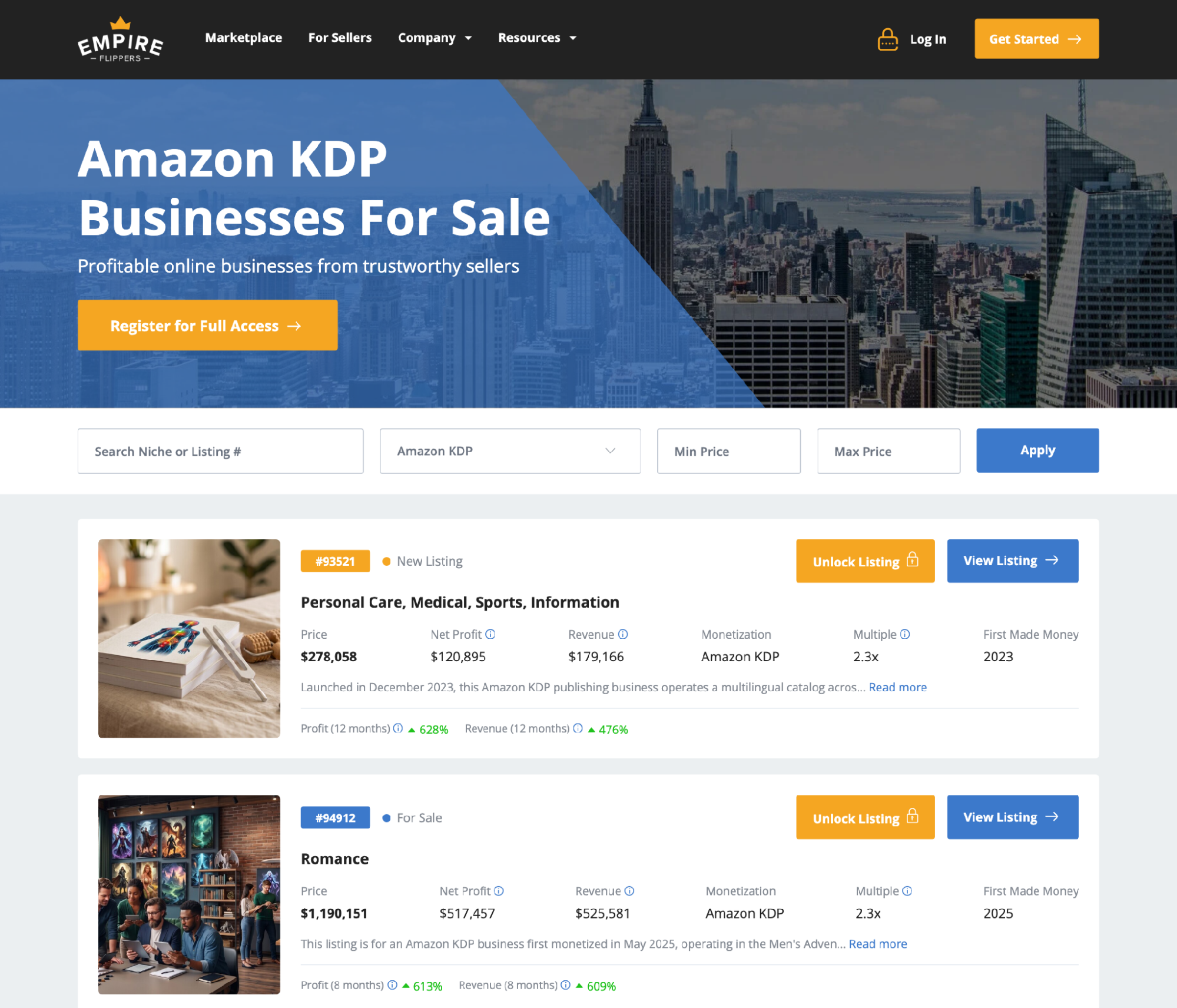
Amazon KDP businesses for sale on the Empire Flippers marketplace, with each listing’s price, net profit, revenue, and multiple.
Does Amazon Allow AI-Generated Books?
Yes. Amazon doesn’t ban AI content. It even offers Kindle Translate, an AI-powered translation service, and audiobooks narrated by a computer-generated “virtual voice” (both in beta at the time of writing).
For more on this, see this guide to publishing a book written by AI on Amazon.
What Amazon does require is disclosure. Under the KDP content guidelines, you have to tell Amazon about AI-generated text, images, and translations when you publish a new book, or when you edit and republish an existing one.
Amazon splits AI use into two groups:
- AI-assisted means you created the content yourself, then used AI to edit, refine, or error-check it. Brainstorming ideas with AI counts here too, as long as you write the text yourself. You don’t have to tell Amazon about any of this.
- AI-generated means an AI tool that creates the actual text, images, or translation. This is what you have to disclose.
The part that’s easy to get wrong is editing. If an AI tool created the content, Amazon counts it as AI-generated “even if you applied substantial edits afterwards,” so “we edit everything heavily” doesn’t get a seller out of disclosing.
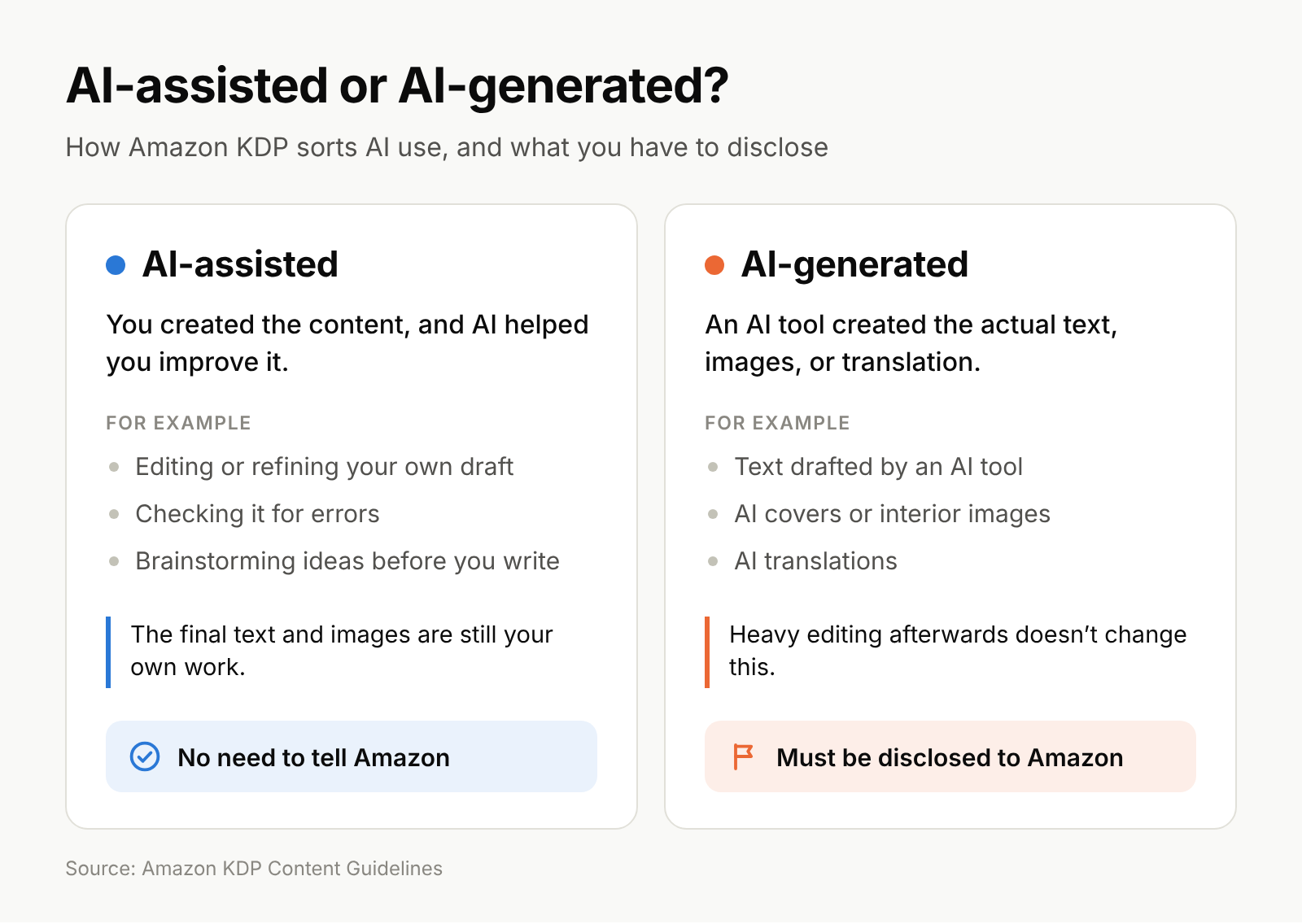
AI-assisted content doesn’t need to be disclosed to Amazon, but AI-generated content does, even after heavy editing. Source: Amazon KDP Content Guidelines
A few more things are worth knowing:
- The disclosure goes to Amazon, not readers. As far as I can tell, the answers aren’t shown on the book’s product page, so you can’t check them from the outside.
- The publisher is responsible for the content. Amazon says it’s on you to make sure AI content follows all of its guidelines, including intellectual property rights.
- Amazon caps new titles. In 2023, it lowered the number of new titles a publisher can create each day, and it confirmed a limit of three to the Authors Guild at the time. That matters if your plan is to grow by volume.
- The rules can change. The disclosure rule only dates back to September 2023, and Amazon can tighten it at any time. A catalog that’s properly disclosed and edited is a safer bet than one that only just passes today.
8 Questions to Ask Before Buying a KDP Business That Uses AI
All the usual KDP checks still apply, so start with this list of KDP due diligence red flags, which covers financials, revenue concentration, ghostwriter contracts, and account health.
The eight questions below are the extra ones to ask when AI is involved.
1. How Much of the Catalog Is AI-Generated?
Ask the seller for a title-by-title breakdown showing how the text, cover, interior images, and any translations were made, and which tools were used. A simple spreadsheet will do, and it could look something like this:
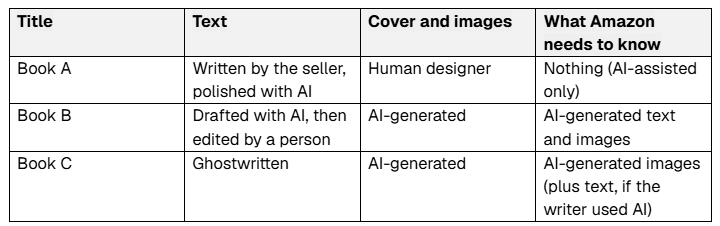
Focus on the top sellers first. If 10 books bring in most of the profit, those 10 matter far more than the long tail.
Don’t just take the seller’s word for it, either. Ask for proof (e.g., ghostwriter invoices, AI tool subscriptions, or draft files with their edit history).
Good sellers are comfortable talking about this. In one episode of the Real Money, Real Business podcast, the seller of a KDP business making around $10,000 per month says plainly that the books are written with AI, then narrated by a human.
If a seller can’t (or won’t) explain how their own books were made, treat it as a red flag.
2. Was the AI Content Disclosed to Amazon?
This is the most important question on the list, as undisclosed AI content is a policy violation, and it becomes your problem once the account is yours. Amazon says it will reject or remove content that doesn’t comply with its guidelines.
KDP asks about AI-generated content on the Content tab, with separate answers for text, images, and translations, and again for each format (ebook, paperback, and hardcover).
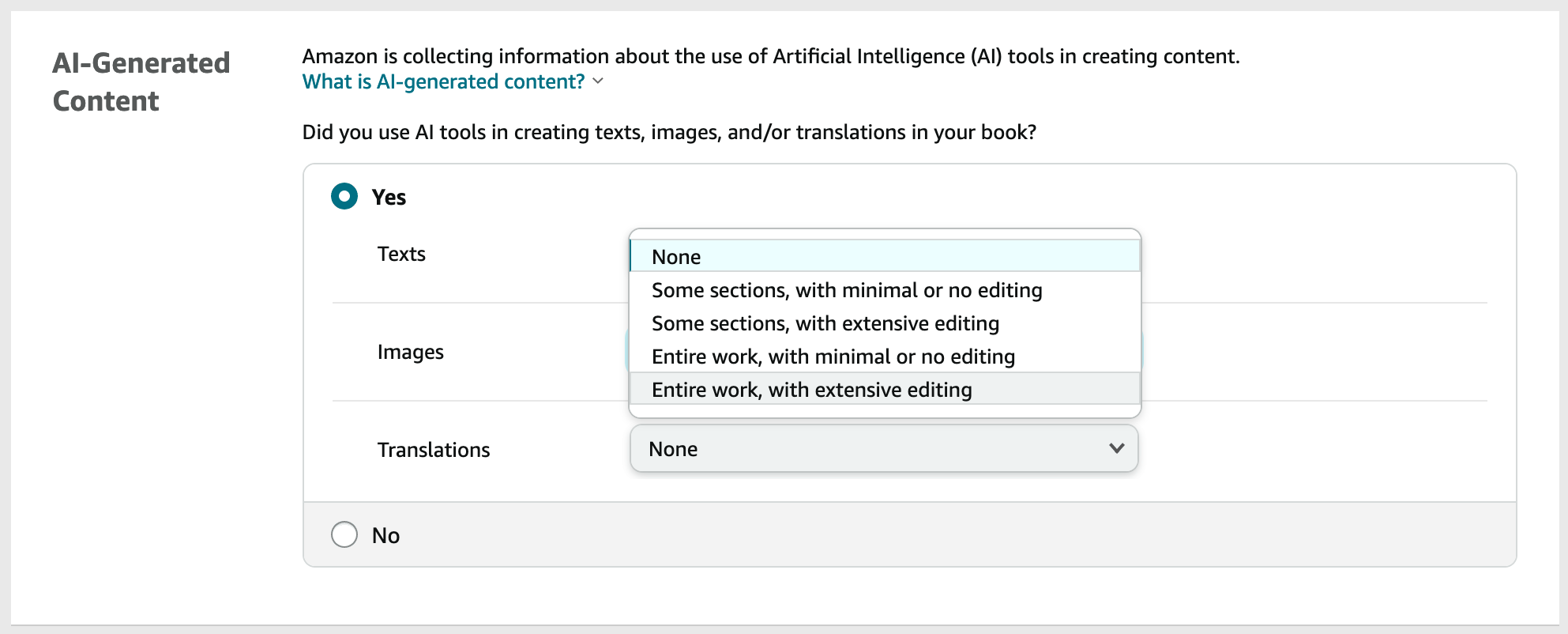
The AI-Generated Content question in KDP, which asks separately about texts, images, and translations. Source: Luminare Press
Ask the seller to show you how they answered for the top-selling titles, ideally on a screen share inside KDP, then compare those answers with the breakdown from question one.
Keep in mind that Amazon only started asking in September 2023, so older books that haven’t been updated since may have no answer on file. You’ll also be asked again every time you update and republish a book, so you need accurate records.
Even if everything looks fine, it’s reasonable to ask the seller to confirm in the purchase agreement that their AI disclosures are accurate.
If you do find undisclosed AI content, ask the seller to republish those titles with accurate answers before closing, or price the risk into your offer.
For example, if the KDP business makes $60,000 per year in net profit and is priced at 2.2 times annual profit ($132,000), and the titles in question account for $12,000 of that, you could value the business on the remaining $48,000, bringing the price down to $105,600.
Alternatively, tie part of the price to those titles still being live six months after closing (i.e., an earn-out).
3. Do the Books Break Amazon’s Quality Rules?
Amazon’s guide to content quality lists content it doesn’t allow because it disappoints customers, and a careless AI workflow can tick several of those boxes at once. The list includes:
- Books that aren’t significantly different from another book in the Kindle Store
- Content that’s too short
- Poorly translated content
- Content that’s excessively reused or repeated within or across books
Watch out for summaries, workbooks, and study guides based on other people’s books too. They’re easy to produce with AI, but Amazon’s guide says companion guides aren’t allowed, with limited exceptions.
Ask the seller whether Amazon has ever removed, blocked, or suppressed a title, and why. Request any emails from Amazon about those titles, along with an export of open items from KDP’s Quality Notifications Dashboard.
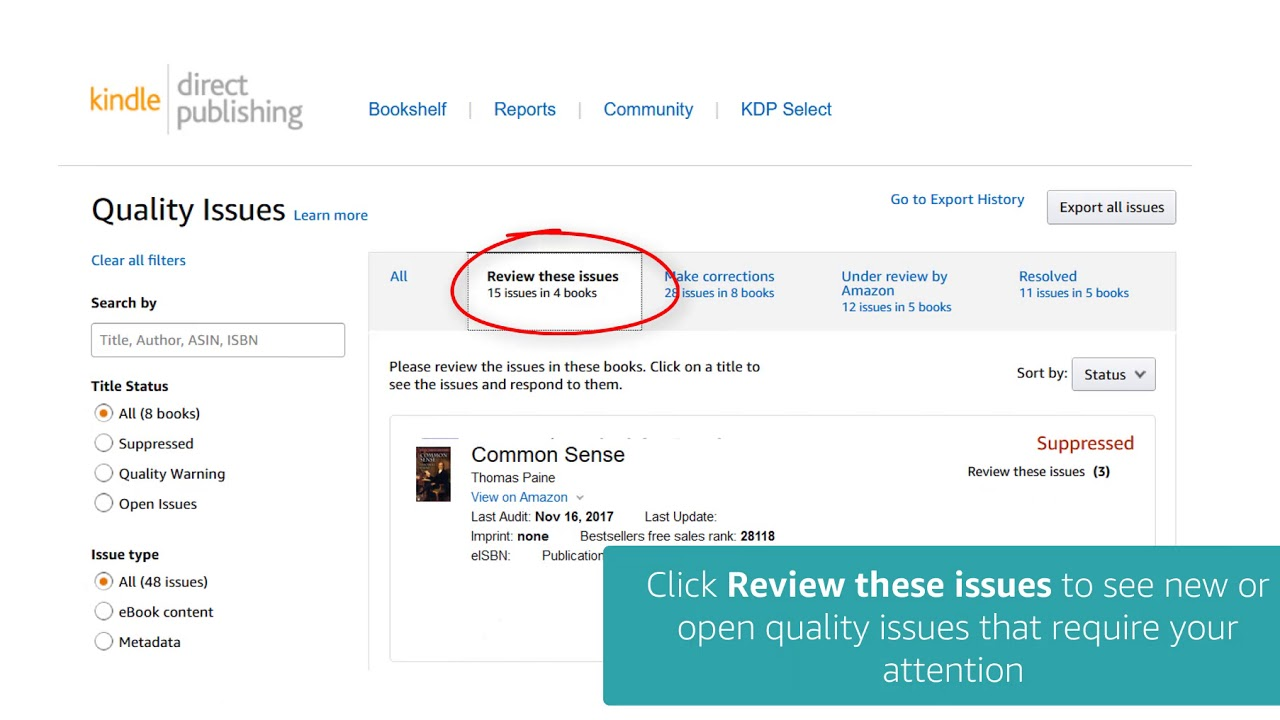
KDP’s dashboard for flagged titles, shown in an older version from Amazon’s own tutorial video, when it was called “Quality Issues.” Source: Amazon KDP
One blocked title out of 100 isn’t a deal-breaker if the seller can explain it. A pattern is a reason to slow down, though, as KDP accounts can be suspended with no prior warning.
4. Are the Books Any Good?
It sounds obvious, but it’s easy to buy a publishing business without reading a single book!
Buy the top five to 10 titles and read them properly (the free “Read sample” preview on each Amazon listing is a quick first pass). Look for:
- The same point repeated in slightly different words
- Generic advice with no examples, stories, or specifics
- Factual errors, or chapters that contradict each other
- Covers with garbled text or odd-looking images
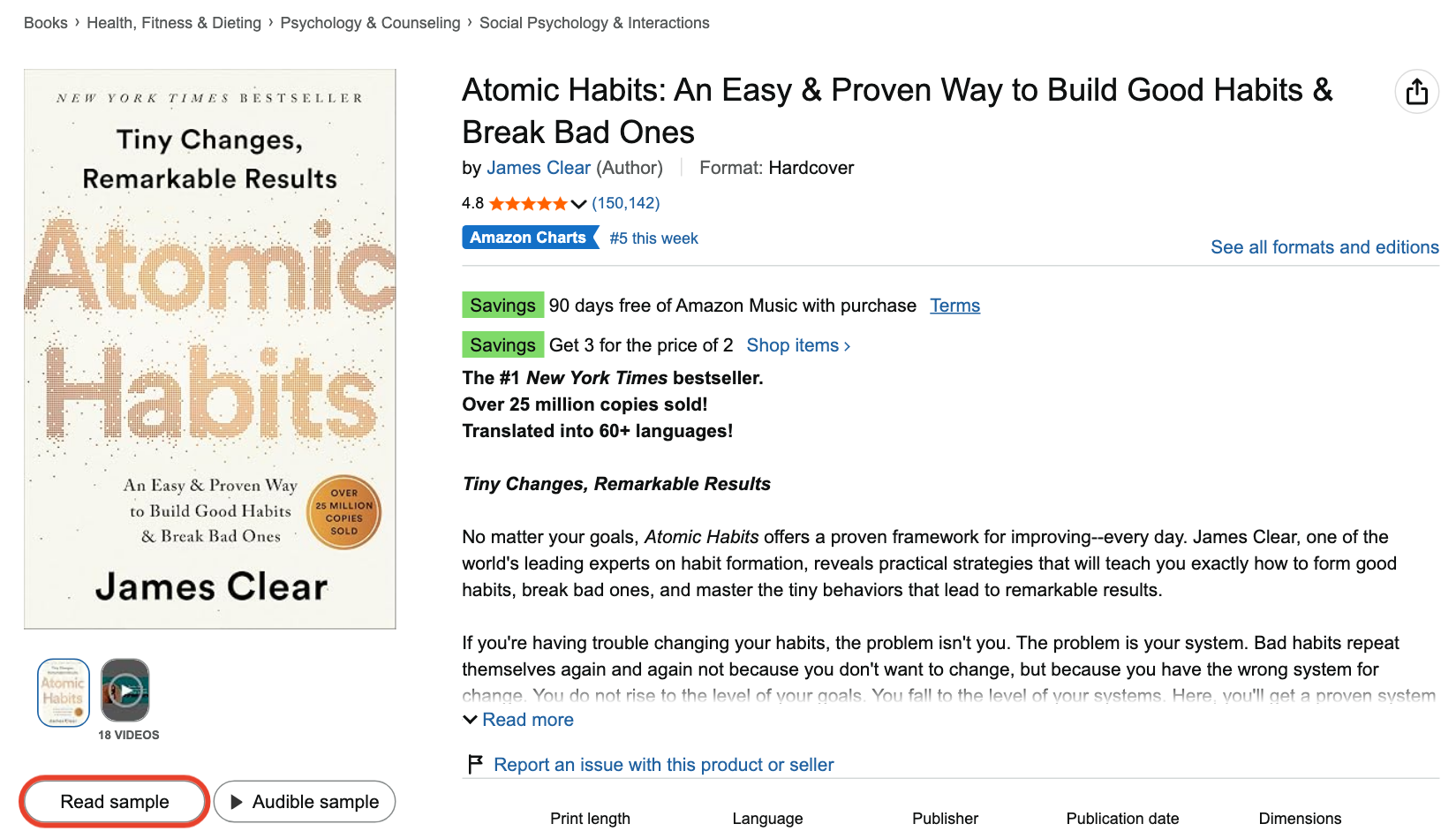
The “Read sample” button on an Amazon book page opens a free preview of the first few pages. Source: Amazon
I wouldn’t rely on AI detectors here, as they’re notoriously inaccurate, and a good editor will tell you more in an hour.
Next, read the reviews, especially the one-star to three-star ones, as readers often say so when a book feels machine-written.
Be extra careful with health, money, legal, and safety topics. In 2023, Fortune reported that the New York Mycological Society was warning people about mushroom foraging guides on Amazon that appeared to be written with AI. One U.K. foraging expert said the guides seemed to encourage tasting mushrooms as a way to identify them.
That’s an extreme case, but the lesson applies to any catalog that gives advice people act on, so ask who checked the facts.
Check the author names as well. Pen names are normal in KDP, but an invented “Dr.” with made-up credentials on a health book isn’t. Amazon’s guidelines don’t allow descriptive content that’s meant to mislead customers, and fake credentials are a fast way to lose readers’ trust.
5. What IP Are You Buying?
You still need to check who owns each book and read the ghostwriter contracts, as you would with any KDP business. AI adds a twist here because U.S. copyright only protects work created by humans.
In a January 2025 report, the U.S. Copyright Office said AI output can be protected only where a human author made enough of the creative choices, and that prompts alone aren’t enough. In March 2026, the Supreme Court declined to hear a challenge to that rule.
I’m not a lawyer, so get proper advice on your deal, but in plain terms:
- A book written by a person, with AI as an assistant, is protected like any other book.
- A book that’s mostly raw AI output may have little or no copyright protection.
- In a mix of the two, the parts a human wrote, arranged, or meaningfully changed can be protected.
If the text isn’t protected, a competitor could copy it, and you’d struggle to stop them. In that case, the value of the business sits less in the words on the page and more in the listings, reviews, rankings, pen names, and the account itself.
If the seller offers copyright certificates, ask what each one covers, as a registration might cover the whole manuscript or only part of it. Ask whether AI-generated text was disclosed in the application too, because the Authors Guild warns that knowingly leaving it out could invalidate the registration.
While you’re at it, run the top titles through a plagiarism checker like Copyscape, as AI tools can repeat other people’s work.
If the seller used ghostwriters, ask whether those writers used AI and whether their contracts say anything about it.
6. How Easy Is the Catalog to Copy?
AI has made books cheap and fast to produce. That’s good for margins, but a competitor can build a similar catalog just as fast.
Search Amazon for the keywords behind the top titles and check the publication dates of the books that come up. If lookalike books have been appearing every week, expect that to continue after you buy.
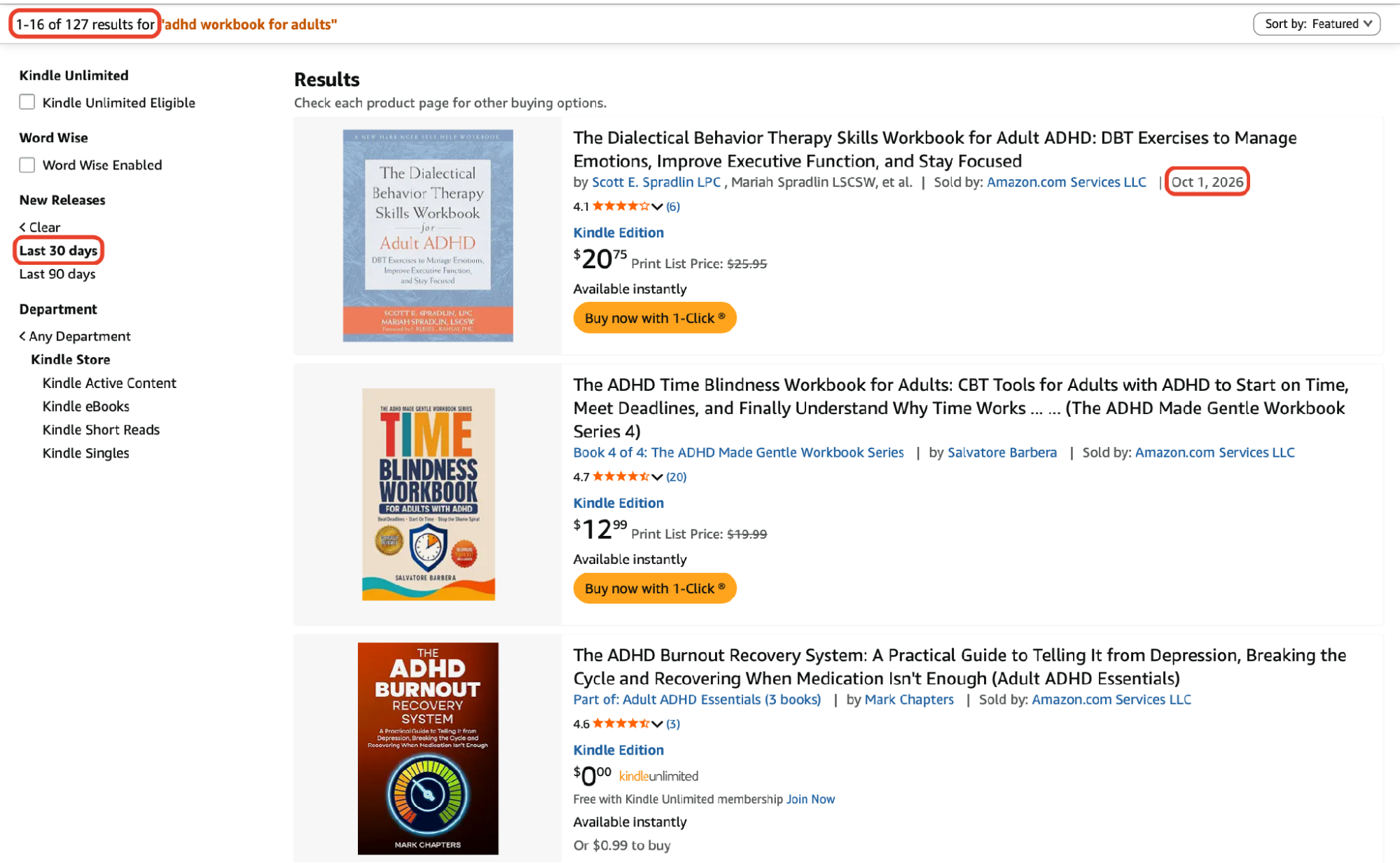
A Kindle Store search for “adhd workbook for adults,” filtered to books released in the last 30 days, returns 127 results. Source: Amazon (October 2026)
Then look for things a competitor can’t copy overnight:
- Titles with hundreds of reviews and a long sales history
- Series and pen names that readers follow
- An email list or social following that the business owns
- Print and audio editions, and sales from outside Amazon
The more of these a business has, the less it matters how the first draft was written.
7. Does Revenue Hold Up Without New Releases?
Some high-volume catalogs run on a treadmill, where a book sells for a few weeks, fades, and gets replaced by the next one. That can be profitable, but the income only lasts as long as someone keeps publishing.
Ask for revenue by title, by month. Then look at:
- How much profit comes from books that are more than 12 months old
- What happens to a typical title’s sales after its first 90 days
- How revenue held up during any stretch when the seller stopped publishing
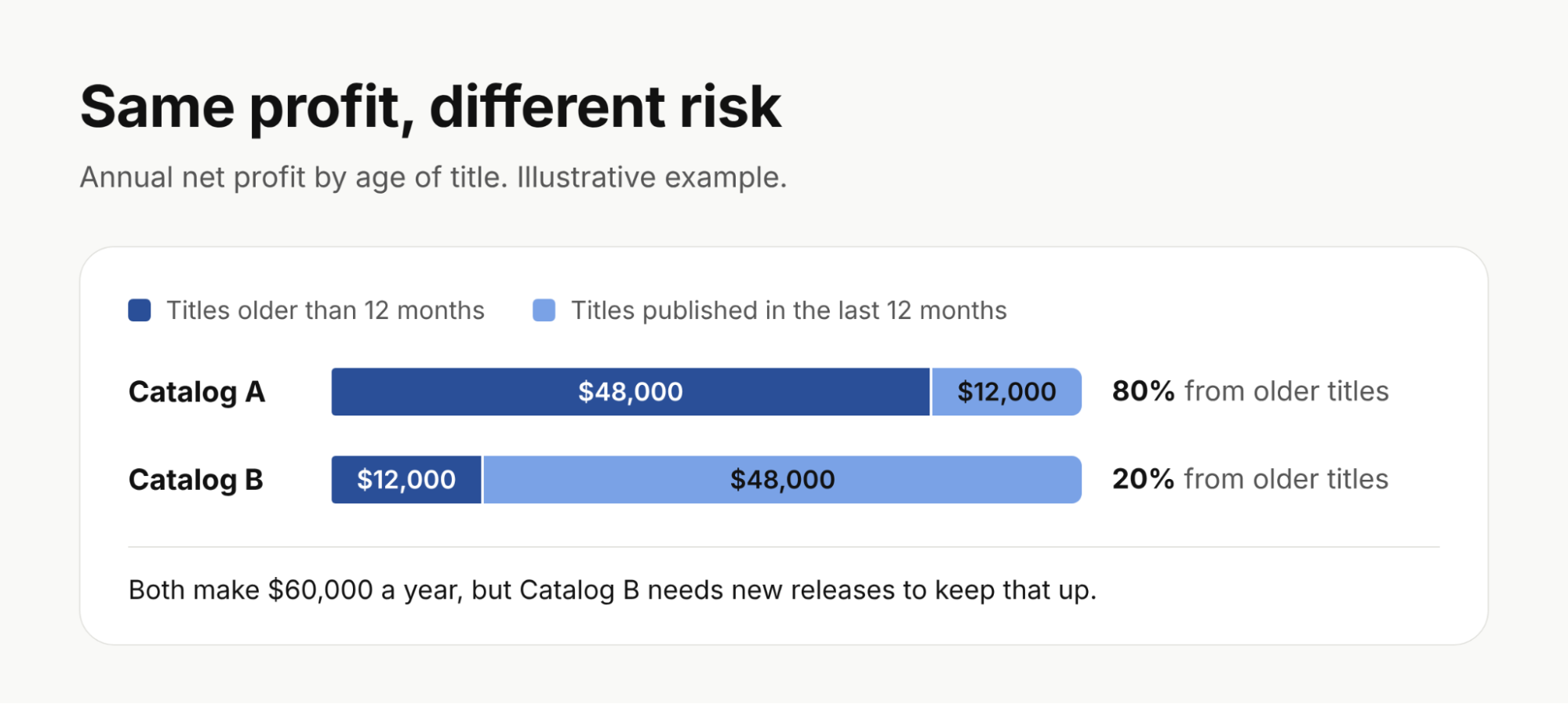
Two catalogs with the same $60,000 in annual profit: Catalog A earns most of it from titles older than 12 months, while Catalog B depends on books published in the last 12 months. Illustrative example.
This matters because of the payback period. According to Empire Flippers’ marketplace data, KDP businesses have sold for an average of 2.2x annual net profit over the past three years.
That is a little over two years of profit, so you need the income to last at least that long. A catalog of titles that have sold steadily for years deserves a higher multiple than one that depends on constant new uploads.
8. Can You Run the Workflow After the Sale?
With a KDP business, the content production system is a big part of what you’re buying, as it’s what creates new books (this video on buying KDP businesses explains why).
With an AI-driven business, that system is a mix of prompts, tools, templates, and review steps, so make sure it’s documented and included in the sale. That means SOPs for research, drafting, editing, covers, and publishing, plus the prompts, templates, and any custom tools behind them.
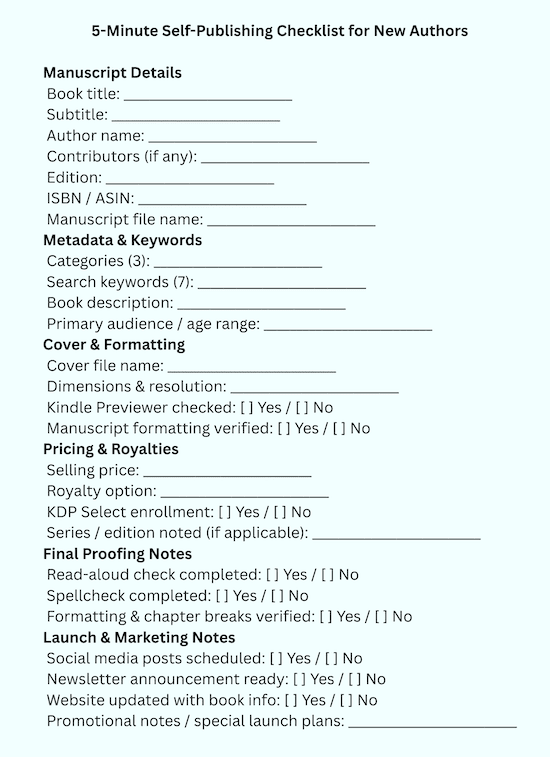
A simple self-publishing checklist. A full SOP for an AI workflow should also cover research, drafting, editing, and covers. Source: Just Publishing Advice
Ask about tool subscriptions too (e.g., the chatbot, AI ebook generator, or image tool the workflow depends on) and whether those accounts can be transferred. Find out who’s involved as well, such as editors, fact-checkers, narrators, and virtual assistants.
Then look at the cost per title. The same video puts cover design at $50 to $500 or more per book and formatting at $50 to $200, with ghostwriting and narration on top.
AI can cut those costs a lot, which is a real advantage if you want to grow the catalog. Just make sure someone still reads each book before it goes live. If the answer to “who does that?” is “nobody,” you know what your first job is after closing!
What This Means for Sellers
If you’re selling, the same questions tell you what to prepare, as buyers worry about surprises more than they worry about AI.
Before you list your business, check your AI disclosures and correct any that are wrong. Keep a record of how each title was made, write up your workflow (prompts, tools, and review steps), and show that a person checks every book before it’s published.
Do that, and your AI workflow becomes a selling point: lower production costs and a system the next owner can keep running.
Documented workflows are one of the things that push a KDP multiple higher, and buyers will ask how your content was produced anyway. You can also use this free valuation tool to get a rough idea of what your business is worth.
The Bottom Line
So, should you buy a KDP business that uses AI?
Yes, if the AI use has been disclosed to Amazon, the books are good, the account is clean, and you can run the workflow yourself.
The most important things to check are:
- How each book was made, and whether Amazon was told
- Whether Amazon has removed or flagged any titles
- The quality of the top-selling titles
- What IP you’re actually getting
- Whether the revenue and the workflow will last without the seller
If something doesn’t check out, it doesn’t have to kill the deal. You can negotiate the multiple down, ask the seller to fix the issue before closing, or walk away.
You can also take a lot of the risk out of the process by buying through Empire Flippers.
They vet every KDP business before it’s listed on their marketplace, and they handle the account transfer for you, which helps because Amazon has no formal way to transfer a KDP account.
That said, vetting isn’t the same as doing your own due diligence, so make sure you go through every question on this list before committing to an acquisition.
Browse Amazon KDP businesses for sale