Faceless YouTube Business vs Other Online Businesses
 August 13, 2026

Faceless YouTube channels have quietly joined the creator economy as a recognized asset class, sitting alongside SaaS businesses, Amazon FBA stores, and content websites as real acquisition targets.
Each model carries a different risk profile, operational demand, and growth ceiling. If you are evaluating where to put your capital or your time, the differences between them matter more than most comparisons let on.
This guide breaks down each model side by side so you can make a confident, informed decision.
Comparing a faceless YouTube channel to other online businesses comes down to five core checkpoints.
- Map revenue models: Understand how AdSense income compares to subscription revenue, affiliate commissions, and direct product sales across each business type.
- Compare valuation multiples: YouTube channel exit valuations differ from SaaS or content site multiples, and those gaps affect your return on investment.
- Assess transferability: Some businesses hand over cleanly; others are tied to a founder’s face, voice, or relationships.
- Evaluate concentration risk: Platform dependency and single-revenue-source exposure vary significantly by model.
- Run model-specific due diligence: Each business type has its own red flags, verification steps, and deal-breakers.
Before You Begin: What You Need for a Fair Comparison
Before comparing models, make sure you have the right context in place:
- Know how each model makes money. AdSense RPM drives YouTube revenue, while SaaS runs on monthly recurring revenue (MRR), Amazon businesses run on unit economics, and content sites run on display ads and affiliate marketing commissions.
- Define your budget and risk tolerance. Each model has a different capital floor and volatility profile.
- Ground your research in verified data. A marketplace with audited financials gives you a reliable baseline when comparing popular online business models.
Step 1: Compare Revenue Models and Earning Potential
Revenue is the most natural starting point for any business comparison, and the differences across these four models are significant enough to shape every other decision you make.
Faceless YouTube Revenue Streams
A faceless YouTube channel earns primarily through the YouTube Partner Program, where AdSense pays out based on RPM (revenue per thousand views). Some channels layer in sponsorships and affiliate marketing, but AdSense typically drives the majority of income.
That dependency is the core risk. If RPM drops, a policy changes, or the algorithm shifts, revenue can fall sharply with little warning.
Note: A faceless YouTube channel with 90%+ of income tied to AdSense carries significant platform concentration risk. Before acquiring, verify how diversified the monetization actually is.
SaaS, FBA, and Content Site Revenue Streams
Other online business models spread income across more sources:
- SaaS businesses earn recurring subscription revenue, which makes monthly income more predictable and easier to project forward.
- Amazon FBA generates product-based revenue, though inventory costs and supply chain exposure add operational complexity.
- Content websites typically combine display ads, affiliate marketing commissions, and sometimes digital products, spreading risk across multiple income streams.
When you compare these models to a faceless YouTube channel, the difference in revenue concentration becomes clear. A content website earning from three sources is structurally less exposed than a channel where a single platform controls the payout.
Step 2: Evaluate Valuation Multiples and Exit Pricing
Once you understand how each model earns, the next question is what it sells for. Valuation multiples vary significantly across business types, and those differences directly affect what you pay at acquisition and what you can expect at exit.
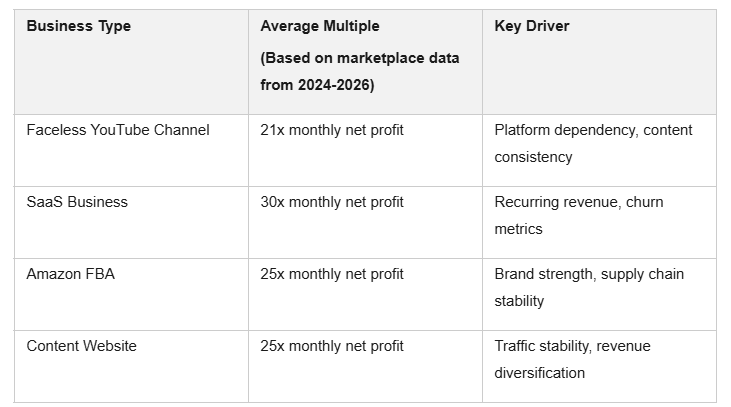
A faceless YouTube channel typically commands lower multiples than a SaaS business because buyers price in platform risk. YouTube controls monetization, and that uncertainty compresses what acquirers will pay.
A SaaS business earns premium multiples because recurring revenue is predictable and churn data gives buyers a clear picture of retention. Amazon FBA sits in the middle, where a well-branded store with a stable supply chain pushes multiples higher, while single-supplier exposure or thin margins pull them down.
Content website valuations hinge on traffic source diversity and how many revenue streams the site runs. Heavy reliance on one traffic channel or one affiliate program reduces the multiple.
If you want to see how these multiples play out across real listings, you can browse available online businesses to compare asking prices against verified financials.
Step 3: Assess Transferability and Platform Risk
Not every business hands over cleanly after a deal closes. Transferability risk is one of the most overlooked factors in online business acquisitions, and it varies sharply by model.
A faceless YouTube channel can look operator-independent on the surface, but if the voiceover style, editing workflow, or content format depends on specific freelancers, replacing them mid-stride risks a noticeable drop in output quality.
Warning: YouTube algorithm shifts and policy changes can reduce a channel’s traffic and revenue with little notice. Unlike a SaaS business or content site, you have no direct control over monetization access. A single policy violation or demonetization event can materially affect returns.
SaaS transfers hinge on codebase quality and how cleanly the developer handoff is documented. Amazon FBA deals carry supplier relationship risk and depend on the health of the existing Amazon account standing.
Content sites with diversified traffic sources and multiple revenue streams tend to be the most transferable of the four models. Strong niche selection and evergreen content reduce the risk that performance degrades after ownership changes.
If you are weighing exit potential alongside transferability, find out what your business is worth before committing to a model.
Step 4: Run Due Diligence Tailored to Each Model
Due diligence looks different depending on which business type you are evaluating, and the gaps between models are wider than most buyers expect. Each model has its own red flags and verification priorities.
Faceless YouTube channel:
- Verify subscriber authenticity and check for artificial growth patterns
- Review RPM trends over 12 months, not just recent peaks
- Confirm content pipeline and freelancer contracts are transferable
- Audit traffic sources for algorithm or policy dependency
SaaS:
- Review churn rate, customer acquisition cost, and codebase documentation
- Identify any technical debt that could require immediate investment
Amazon FBA:
- Check supplier agreements, inventory levels, account health, and brand registry status
Content sites:
- Audit organic traffic trends, backlink profile, content freshness, and revenue source mix
A faceless YouTube channel acquisition requires extra scrutiny on platform-specific risks. Unlike a newsletter acquisition or a SaaS deal, you are buying an asset that a third party can demonetize without notice. Treat that as a deal variable, not a footnote.
Frequently Asked Questions
Is Faceless YouTube Still Profitable?
Yes, faceless YouTube channels continue to generate real income through AdSense, sponsorships, and affiliate marketing. Profitability depends heavily on niche selection and RPM, with high-value niches consistently outperforming general content. The model works, but it requires the same operational discipline as any other online business.
How Does Acquiring a Faceless YouTube Channel Compare to Buying a SaaS or FBA Business in Terms of Risk and Return?
A faceless YouTube channel typically carries higher platform risk and lower valuation multiples than a SaaS business. Amazon FBA introduces inventory and supply chain exposure that YouTube does not. Each model trades off differently between predictability and upside.
What Should Buyers Look for During Due Diligence on a Faceless YouTube Channel?
Prioritize RPM trends, subscriber authenticity, and whether the content workflow transfers cleanly to a new owner. Platform dependency is the variable most buyers underestimate.
Which Faceless Niche Pays the Most on YouTube?
Finance, technology, and health consistently produce the highest RPM for faceless YouTube channels. These niches attract advertisers willing to pay premium rates, which directly increases revenue per view.
Pick the Model That Matches Your Risk Profile
No single model is universally better. The right fit depends on your risk tolerance, how much time you can commit, and what growth looks like for you.
A faceless YouTube channel offers real creative upside, but platform risk is always part of the equation. SaaS and FBA offer more predictable income with heavier operational demands.
If you are ready to move from comparison to action, Empire Flippers gives you access to verified listings across all four models, with vetted financials and a team that can help you match the right business to your goals. Book a call with one of our expert business advisors to find out which business model best suits your needs.
Start with one comparison factor, such as revenue concentration, valuation multiple, or transferability, and build your decision from there.