Buying a Marketing Agency vs Building One From Scratch
 Updated on June 25, 2026

Owning a digital marketing agency is a great path to recurring, service-based revenue. Before you get there, though, you face a decision that shapes your timeline, your risk exposure, and how much capital you put on the line: do you buy an existing agency or build one from scratch?
Both paths carry real potential, and both carry real costs. Buying gets you to revenue faster but requires upfront capital. Building gives you control, but demands time you may not have. This guide walks through both options so you can make the call that fits your situation.
Buying vs Building an Agency in Brief
Here is a quick-reference skeleton of the full decision process:
- Define your budget, available skills, and how quickly you need cash flow coming in.
- Evaluate the buying path: you get existing revenue, established clients, and standard operating procedures from day one.
- Evaluate the building path: lower upfront cost and full control, but a longer ramp to your first dollar earned.
- Compare realistic timelines for each option against your personal financial runway.
- Choose the path that fits your situation, or consider a hybrid approach where you build lean while watching acquisition opportunities.
Before You Begin: Prerequisites for Either Path
Before you commit to either path, take stock of where you actually stand. Two people can read the same guide and reach opposite conclusions based on their starting position.
Run through these three checkpoints:
- Capital: How much can you deploy upfront? Buying requires acquisition capital plus working capital reserves. Building requires a runway to cover your costs before clients pay consistently.
- Skills: Do you have operational experience running an agency business model, or domain expertise in a specific service type?
- Risk tolerance: Can you absorb client concentration risk from an acquisition, or would slow organic growth suit you better?
Note: Agency type changes the calculus significantly. SEO agencies often carry more transferable systems and are easier to acquire without deep founder involvement. PPC and content agencies tend to be more relationship-dependent, which makes the build path comparatively more attractive if you already have those skills.
When reviewing any acquisition, request a profit and loss statement and define your acquisition criteria before you start looking. Clarity upfront saves time on both sides.
Step 1: Evaluate the Acquisition Path
The buying path has a lot going for it, but it also comes with deal structures and risks that deserve a close look before you commit.
What You Gain When You Buy
Buying an existing agency means you skip the hardest part of building one: getting to revenue. From day one, you inherit paying clients, a functioning team, documented SOPs, and established brand equity. That combination compresses your time-to-profit significantly compared to starting from zero.
You also get cash flow history. A seller who can show 12 to 24 months of consistent profit and loss statements gives you something a new build never can: proof the model works.
Browse available agency listings to see what established agencies are currently on the market.
Risks and Deal Structures to Watch
The most common deal structures you will encounter are full cash purchases, seller financing, and earnouts. Seller financing lets you pay part of the purchase price over time, while earnouts tie a portion of the payment to post-acquisition performance, often linked to client retention targets. Both reduce your upfront exposure but add complexity to the transition period.
Revenue multiples for digital agencies typically fall between 2x and 4x annual profit, depending on niche, client diversity, and size. Churn rate and contract length directly affect where a deal lands in that range.
Warning: Asking the right questions before buying an agency helps you mitigate a lot of risks. Never skip due diligence on client concentration and staff dependency. If a single client accounts for 40% or more of revenue, losing them after the deal closes can unwind the entire acquisition. Review client contract terms, churn rate, and which team members are essential before you sign anything. Thorough acquisition research consistently shows this is where buyers get caught off guard.
Step 2: Evaluate the Build-From-Scratch Path
If the acquisition path feels like too much capital or complexity for where you are right now, building from scratch is a genuinely viable alternative, provided you go in with realistic expectations.
What You Gain When You Build
Building a digital marketing agency from scratch gives you something an acquisition cannot: complete control. You choose the services you offer, the clients you take on, the culture you create, and the brand you put into the world. There is no inherited baggage, no awkward client relationships to manage, and no systems you have to unlearn before building your own.
Your upfront capital requirement is also lower. You are not paying a multiple on someone else’s profit. According to industry analysis, the tradeoff is time, and most new agencies take six to twelve months or longer before generating consistent, meaningful revenue.
You also build your standard operating procedures from direct experience, which means they reflect how your team actually works rather than how a previous owner preferred things.
Tip: Do not assume you will close your first client in week one. Budget for at least six months of operating costs before you expect any predictable cash flow. If you have a shorter financial runway than that, the acquisition path discussed in Step 1 may be worth revisiting.
Common Pitfalls in the Early Months
The early mistakes that sink new agencies tend to follow a pattern:
- Underpricing services to win clients fast, then struggling to raise rates later
- Skipping SOPs entirely, which creates chaos as soon as you hire your first person
- Chasing every niche at once, which makes it nearly impossible to build a clear exit strategy or a repeatable sales process
Pick one service type, build the process, and then expand.
Step 3: Compare Both Paths and Pick Your Route
With both paths laid out, the next step is putting them side by side so you can make a clear-eyed call based on your own circumstances.
Side-by-Side Decision Criteria
Here is how the two paths compare across the factors that matter most:
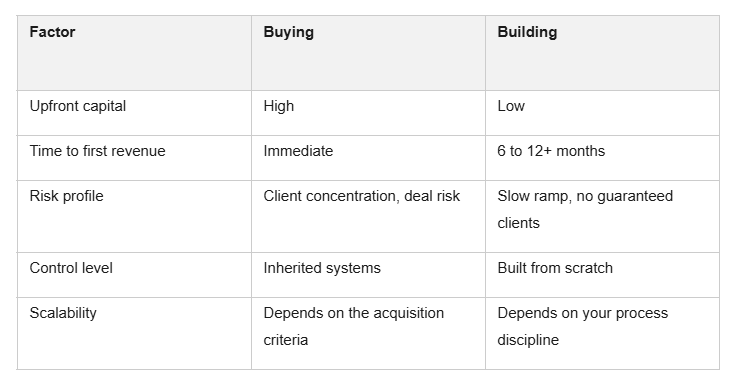
Buying suits you if you have capital available, want immediate cash flow, and have a lower tolerance for the uncertainty of starting from zero. Building suits you if capital is limited, you have strong domain skills, and you can sustain yourself through a longer ramp period.
If you are still weighing the buy versus build decision, the right answer usually comes down to your financial runway and how quickly you need the business to generate income. If you want personalized guidance on which path fits your capital, skills, and timeline, you can speak with one of our expert business advisors before committing to either direction.
The Hybrid Option: Acquire Small, Then Grow
There is a third route worth considering. Acquire a small agency as your foundation, then layer your own systems, processes, and new clients on top of it.
This approach gives you immediate cash flow and client retention from day one, while still letting you build toward the agency you actually want. It is a lower-risk entry point than a large acquisition, and a faster path to revenue than building from nothing.
Frequently Asked Questions
Is It Better to Buy a Business or Start From Scratch?
It depends on your capital and timeline. Buying gives you immediate revenue and an existing client base, which often helps you scale your agency much faster post-acquisition. On the other hand, building costs less upfront but takes longer to generate consistent income. Your financial runway usually makes the decision for you.
What Should You Look for During Due Diligence When Buying an Agency?
Focus on client concentration, contract terms, churn rate, and staff dependency. Due diligence should confirm that revenue is not tied to one or two clients, and that key team members are willing to stay post-acquisition.
One important thing to check is whether client contracts can be transferred to a new owner. Some agreements include change-of-ownership clauses that allow clients to terminate their contracts if the business is sold. Successfully retaining and transferring clients post-acquisition is essential, as keeping your client base intact helps maintain the business’s revenue and stability.
How Are Digital Agencies Typically Valued for Acquisition?
Most digital agencies are priced using a revenue multiple applied to annual profit, typically between 2x and 4x. The exact multiple reflects niche, client diversity, contract length, and how transferable the business is without the founder.
What Happens to Existing Clients After an Agency Acquisition?
Client retention depends heavily on how the transition is handled. Buyers who communicate early, maintain service quality, and honor existing agreements tend to see stronger retention than those who make immediate operational changes.
Your Next Move Starts With Clarity
Neither path is universally better. Buying suits one set of circumstances, and building suits another. What matters is how honestly you assessed your capital, your skills, and how long you can operate before the business pays you back.
Go back to the prerequisites section if you skipped it, and start there. Once you know where you stand, commit to one direction and move. Clarity on your starting position is what turns this decision from abstract to actionable.