
This Week in M&A Issue #241
 June 15, 2026

Happy Friday!
Today’s trend of the week is “the FIFA World Cup”. ⚽
The FIFA World Cup started yesterday and could be a major sales opportunity for online businesses.
According to consumer research from Numerator, shoppers are expected to drive an estimated $7.5 billion in consumer spending during the tournament.
Most shoppers expect to spend less than $100, but average projected spending is around $74 per person, which is higher than estimates for both the Super Bowl and Winter Olympics.
Consumers are actively looking for products that enhance their viewing experience, creating opportunities for brands to launch themed promotions, bundles, special offers, and content tied to the tournament.
With the tournament running for more than a month, businesses have a longer window to capture attention and sales compared to many other major sporting events.
Today we have for you:
- Walmart’s online marketplace hits fastest growth rate in years
- Reddit’s search dominance grows across every niche
And:
- LinkedIn is now a top source for AI citations
- The Amazon Aggregator bubble didn’t kill this exit story
- Amazon is cracking down on shipping times
Alright, let’s dive in.
ecommerce
-Jun-11-2026-01-31-45-9308-PM.gif)
Image Source: Giphy (OmlieConsulting)
Walmart Marketplace Growth Accelerates as Sellers Flood In
Walmart’s third-party marketplace is growing at its fastest pace in years.
In the first quarter of fiscal 2027 (ending April 30, 2026), Walmart Marketplace sales grew close to 50% year over year, according to Marketplace Pulse, the strongest growth rate in multiple years.
Walmart’s overall U.S. e-commerce business has now grown more than 20% for five straight quarters, showing steady demand for its online offering.
A big reason for the surge is the number of sellers joining the platform. Walmart now has over 200,000 active marketplace sellers, with more products being added every day. The onboarding process has also become easier, which has helped attract more brands and smaller sellers.
Fulfillment has also become a major competitive lever. Walmart Fulfillment Services and expanded delivery infrastructure are helping close the gap with Amazon on shipping speed, including faster delivery badges and broader store-fulfilled logistics. This has made the marketplace more viable for both large brands and smaller sellers who need reliable delivery performance to compete.
Walmart is also building out the rest of its e-commerce business at the same time. Advertising and membership products are becoming more important, sitting alongside marketplace sales as part of a broader digital strategy. This means sellers are not just getting access to a storefront, but also to an ad system that can help them get discovered.
For sellers, this gives them another serious channel outside of Amazon. For Walmart, it means more product selection without holding inventory, plus more ways to earn from the platform itself.
Walmart is still smaller than Amazon in e-commerce, but it is growing faster than ever, and it’s doing so with a much stronger seller and fulfillment setup than it had just a few years ago.
Search
Reddit Now Holds More Than 10% of Google’s Top Search Positions
Reddit is becoming an increasingly dominant presence in search results, particularly after Google’s May core update.
An SE Ranking of 100,000 keywords found that Reddit increased its share of top-three organic “blue link” positions across all 20 niches it tracks. Reddit now holds 10.24% of all top-three positions, up from 8.56% after the March update. Even more notable, the number of keywords where Reddit ranks in the number one position jumped 54%, rising from 8,993 to 13,872.
Reddit saw the strongest gains in experience-driven categories such as ecommerce (up from 11.50% to 14.11%), sports (9.75% to 12.77%), education (10.46% to 13.49%), and pets (14.87% to 18.05%).
At the same time, YouTube moved in the opposite direction. Its share of top-three organic rankings fell to 2.14%, suggesting Google may be shifting more video content into dedicated video search features rather than traditional organic listings.
The update also reshuffled rankings significantly. Nearly 20% of pages that previously ranked in the top 10 disappeared from the top 100 altogether. However, unlike the March update, most new top-three rankings came from pages that were already performing reasonably well rather than from sites making dramatic leaps from lower positions.
There was some good news for sites hit by previous updates. Roughly one-third of domains that lost top-10 rankings during the March update recovered their positions after the May rollout. Still, nearly 68% remained below their previous visibility levels.
The growing influence of Reddit suggests that Google is placing greater value on authentic user perspectives, creating new opportunities for brands that genuinely understand their audiences.
AI Visibility
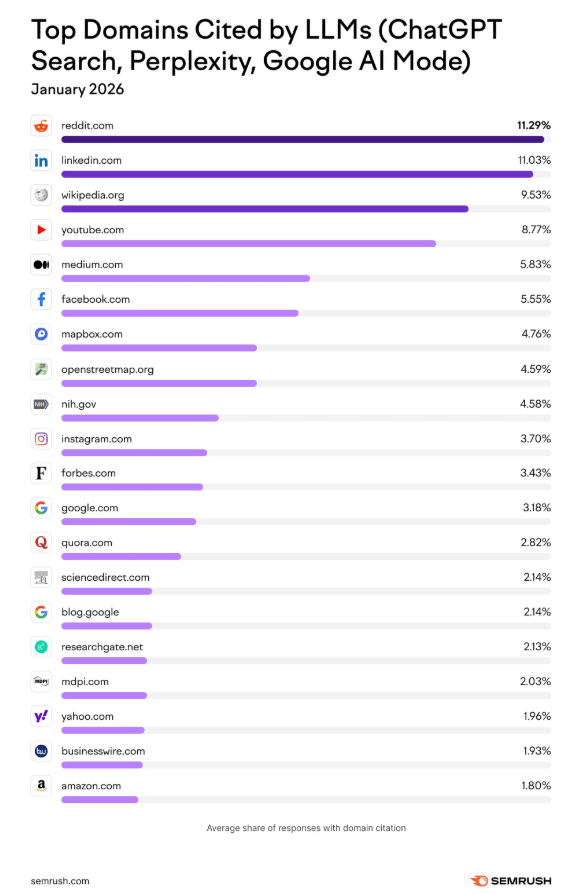
Image Source: Semrush
LinkedIn is the Second Most-Cited Platform in AI Answers
According to new research from Semrush, LinkedIn is now the second most-cited domain across major AI platforms like ChatGPT Search, Google AI Mode, and Perplexity. It shows up in around 11% of AI-generated answers, ahead of Wikipedia, YouTube, and many major publishers.
The study is based on 89,000 LinkedIn URLs that appeared inside AI responses, making it one of the largest datasets we have so far on how AI systems choose what to cite. ChatGPT Search and Google AI Mode rely on LinkedIn the most, while Perplexity uses it less often.
Semrush found semantic similarity scores between 0.57 and 0.60, which suggests AI tools often reflect the meaning and framing of LinkedIn content quite closely.
What makes this research particularly useful is that it focuses on citations rather than engagement metrics. So the goal is not more likes, comments, or followers. It’s about increasing the chances that AI systems reference your content when answering questions.
So what actually gets cited?
Content types that perform best in AI citations:
- Original posts outperform reshared content (about 95% of cited posts are original)
- Educational content leads, especially practical insights, frameworks, and how-to guidance. AI systems prioritize real expertise over promotional content
- Long-form articles perform strongly, especially in the 500 to 2,000 word range
- Shorter feed posts still work well when they are insight-driven (roughly 50 to 299 words is the sweet spot)
- Consistent posting matters more than virality (many cited authors post at least 5 times in a 4-week window)
- Employee posts are increasingly important, often carrying more weight than company pages in ChatGPT and Google AI Mode
- Articles and newsletters are the most frequently cited formats
If AI is reshaping brand discovery, LinkedIn is becoming one of its main source feeds. Visibility on LinkedIn is now starting to translate directly into visibility inside AI answers, so it’s a channel worth paying attention to.
Read All About It!
💰 List of grants for entrepreneurs: and tips for winning them
🔍 HubSpot’s AI Market Research Assistant: prompts for smarter insights
🌐 Most popular alternatives to Chrome and Safari: browser wars
💼 A first-time buyer’s playbook: 374 Acquiring Minds episodes summarized
M&A
A $10M Amazon Brand Turned Into a $325M Exit
Thrasio raised around $3B and hit a peak valuation of about $10B, becoming the poster child for the Amazon aggregator boom. Thrasio then filed for bankruptcy in February 2024 after operational inefficiencies, complexities, and debt load caused its downfall.
But, as Fan Bi recently outlined on LinkedIn, one of its acquisitions tells a different story.
Thrasio bought a small Amazon brand called Frosty Dream Inc. in 2020 for roughly $10M. It sold stain removal products like Road Spill and Emergency Stain Rescue, later rebranding as Miss Mouth’s Messy Eater.
While Thrasio collapsed, this brand kept growing.
It expanded into Target, hit #1 in its Amazon category, and built more than 90,000 reviews. A big part of its growth came from TikTok parents showing real-life demos of stains being removed from kids’ clothes.
That momentum led to a major exit.
Church & Dwight just acquired Miss Mouth’s for $325M. It was doing about $80M in revenue and $28M in EBITDA, with strong 35% margins. That’s around 4.1x revenue and 11.6x EBITDA. It also means more than a 30x return on the original $10M acquisition.
In 2022, Church & Dwight also bought Hero Cosmetics, an Amazon pimple patch brand started in 2017. That deal was around $630M on $115M revenue, again with strong margins and category leadership.
Church & Dwight’s growth strategy is to find the #1 brand in a category, Amazon-native, with strong margins and simple operations, then plug it into their global distribution system and scale it further.
So while the aggregator model failed in its original form, that doesn’t mean Amazon FBA brands stopped being valuable. Aggregators mostly failed through mismanagement, but growth through Amazon FBA acquisition is still alive and well. Well-run Amazon-native brands with strong fundamentals continue to be highly valuable acquisition targets.
Amazon
The End of “Safe” Handling Times on Amazon Listings
Amazon is changing how it handles seller-fulfilled shipping times, and it’s going to affect how many sellers set up their listings.
From June 29, 2026, Amazon will start cracking down on SKUs where the listed handling time does not match what actually happens in practice.
If Amazon sees that you’re consistently shipping faster than your listed handling time, it will flag those listings. Sellers then get 30 days to update their settings. If nothing changes, Amazon can step in and automatically adjust the handling times. In some cases, it may even take over management of those SKUs and temporarily protect sellers from late shipment penalties while things are being adjusted.
On the surface, this looks counterintuitive. Many sellers deliberately set longer handling times as a buffer for disruptions like carrier delays, staffing issues, or unexpected spikes in demand. But Amazon’s position is that inflated handling times distort delivery promises shown to customers. That can lead to worse shopping experiences, even if sellers consistently ship faster than expected.
Amazon is also leaning more on automation by encouraging sellers to use Automated Handling Time, which sets shipping windows based on real performance data instead of manual estimates.
Amazon is clearly pushing for tighter, more accurate shipping promises, and less flexibility when it comes to conservative handling times, even if those buffers have traditionally helped sellers manage risk.
Money Nomad
.png)
Looking for a side hustle?
Try Money Nomad, our sister marketplace built specifically for profitable side hustles and micro-businesses that are too small for Empire Flippers.
Check out this recent listing available on the Money Nomad Marketplace:
Listing #10035 – $26,500.00
affiliate, display ads | sports & fitness
This 10+ year-old golf content site generates $205/month in revenue through display ads and affiliate partnerships. With a curated directory, product reviews, and strong organic traffic, it offers a passive income stream in a well-defined sports niche. Learn More
Subscribe to the This Week in M&A Newsletter
to Get Content like This in Your Inbox Every Friday
