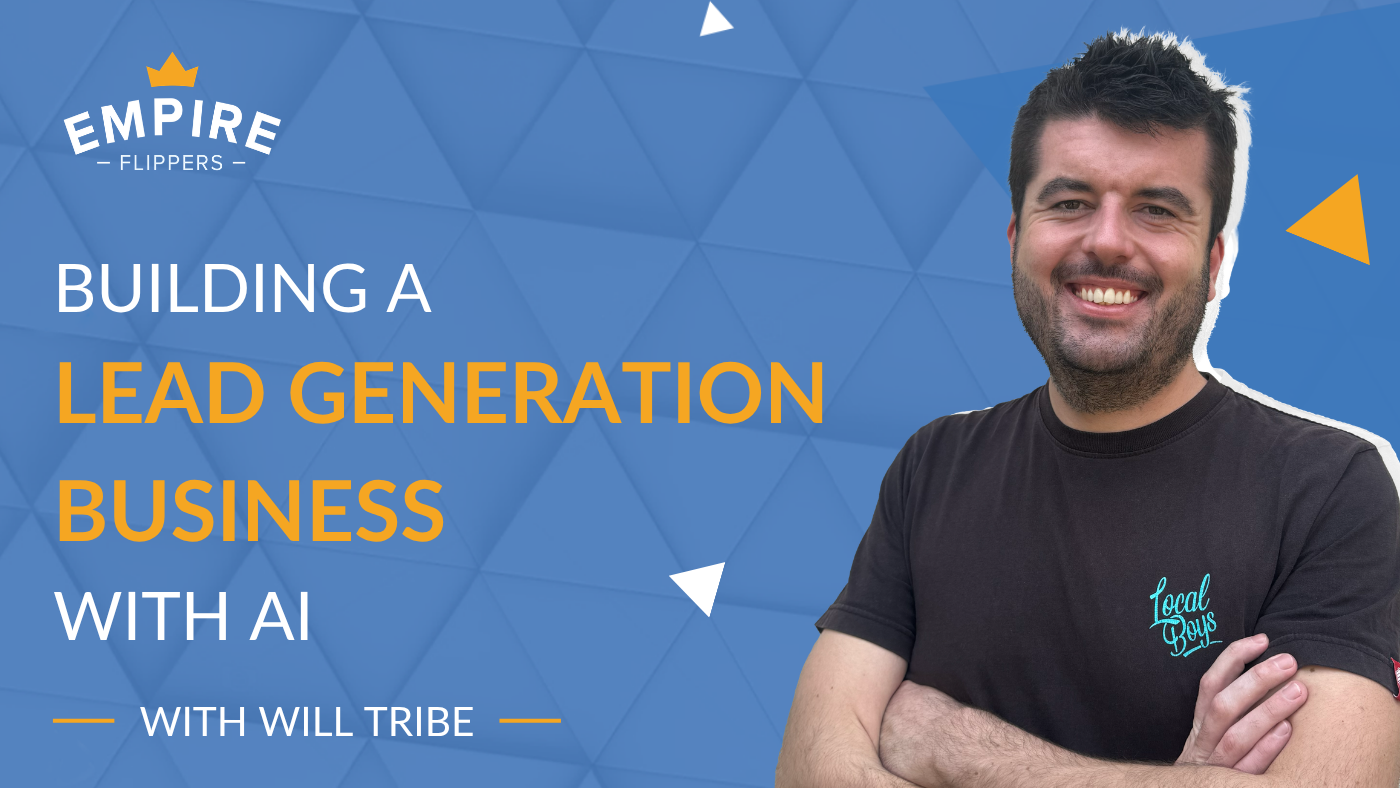
Building a Lead Generation Business With AI With Will Tribe [Ep.224]
 October 6, 2026
 SEO has changed dramatically over the past few years, but that doesn’t mean the opportunities have disappeared.
In this episode, Greg sits down with SEO expert and lead generation operator Will Tribe to break down what’s working in search today and why lead generation may be one of the more resilient opportunities for online business owners.
Will has been doing SEO since 2009 and has moved between affiliate SEO, foreign SEO, and lead generation. After seeing the economics of affiliate SEO change, he returned to lead gen and has since used AI to rapidly test new niches and build out a large portfolio of websites.
We dive into how Will finds lead generation opportunities, why he focuses on smaller geographic markets and exact-match domains, and how he tests a niche before committing significant resources.
Will also explains how AI has changed the economics of SEO. Instead of spending months building a site and hoping it works, he can now launch inexpensive tests, gather data quickly, and double down on the opportunities that show potential.
If you want a practical look at where SEO and lead generation are heading, and how AI is changing the way these businesses are built, this episode is worth a listen.
Topics discussed in this episode:
-
01:52 – Will’s background from affiliate SEO to lead generation
-
08:08 – Finding the right lead-gen partners
-
13:00 – Do exact-match domains still work?
-
17:21 – How Will uses AI to deploy and test SEO sites
-
24:28 – How to test a niche and find opportunities quickly
-
27:20 – How soon Will starts seeing results after launch
-
31:00 – How Will manages a portfolio of over 2,000 websites
-
35:30 – What Will’s SwitchMonster tracking tool does
-
30:10 – Where is the future of lead gen going?
-
47:33 – How to structure lead-gen deals
Mentions:
Sit back, grab a coffee, and learn how to use AI to build a lead generation business!
Listen to this episode



Transcript
Welcome to the Opportunity Podcast, where entrepreneurs come to learn from real buyers, sellers, and industry experts about the lesser-known growth opportunities to build their online business empires.
We'll uncover tactics veteran online business entrepreneurs have used to build, buy, flip, and sell their way toward personal wealth. Sit back, grab a coffee, and get ready to uncover hidden growth secrets. The Opportunity Podcast starts now.
Welcome to another episode of the Opportunity Podcast. I'm your host, Greg Alfred, the head of marketing over here at Empire Flippers. Today, I'm speaking to a very good old friend of mine, Will Tribe.
This is kind of his debut appearance in the media world. He usually is pretty, like, “No,” but he's now the headline speaker at Chiang Mai SEO coming up this year. This guy is killer when it comes to lead gen. He's really down to earth and explains things very, very well.
So, if you've ever wondered how you can go about building a local lead gen empire, and how you can use AI to send off literally dozens and dozens of cheap tests to test different niches, this is the episode for you.
Will is a fantastic dude. He just launched his own call-tracking software as well, Switch Monster, which we talked a little bit about. That will be linked down below, as well as ways to connect with Will.
With that said, I'll see you on the inside.
Well, I have Will Tribe with me here today, the founder of Switch Monster, a very old friend of mine, and someone I've been pestering to get onto this podcast for probably a couple of years. At this point, you finally broke out of your shell, and here you are, man.
For everyone who doesn't know the legend that is Will Tribe, why don't you introduce yourself?
**Will:** Sure. I've been doing SEO since 2009. I live in Chiang Mai. Originally, I was doing a few ClickBank affiliate sales and things like that. I moved into lead generation around 2013 or 2014.
I did the whole Alex Becker Source Wave, rhinoplasty, rank-and-rent kind of thing. That's where I got my start with Source Wave.
**Greg:** Were you also doing rhinoplasty? I think everyone has done rhinoplasty.
**Will:** No, I tried to do LASIK in Alaska.
**Greg:** Yeah.
**Will:** I was like, “I want to be different. I don't want to be the rhino of plastic.” But I got a lot of my start with Alex Becker's stuff.
**Greg:** Nice.
**Will:** That was massive for me in terms of understanding SERP potential. He called it the “shy landlord method,” which was brilliant for me. I didn't want to make phone calls, and if I was going to make a business phone call, I'd rather be coming at it from a position of already having value.
So, we had leads coming in, as opposed to offering an SEO contract on the hope of future results. We did that SERP Shaker-style. Then those websites carried on growing. Some of them got hit in about 2016.
Then we went pretty hard into affiliate SEO and age domains. We scaled it quite hard. We bought all the products, had a studio, tested the products, and things like that. We got slapped by Google in 2020 or 2019. Then, not long after that, Amazon halved the commissions as well.
The categories we were in were big, so that taught me not to be too overly dependent on one thing. If you're going to be overly dependent, restrict it. If you're going to do affiliate, have multiple sources of traffic. If you're going to do just SEO, don't put all your eggs in Amazon or something like that.
I also did a bit of foreign SEO around then. Then, we got back into lead gen in about 2022, and we've been scaling with AI for about two years now.
**Greg:** Right on. I feel you on not relying entirely on affiliate or SEO. I always tell people you should really have three different ways to make revenue and three different ways of building traffic.
Obviously, most businesses we sell only have one traffic source, usually. But you never know in the internet world what's going to happen.
I've never sold an online business, so I've typically just been a holder. I always hold on to the companies and go down with the ship. These diamond hands are drowning.
I'm lying. You always want to sell, too. Everyone always wants to sell at the peak, right?
**Will:** Yeah.
**Greg:** And then when the affiliate apocalypse happens—and we'll get into that, I'm sure—a lot of my friends got out of the affiliate marketing world at the advent of AI. Suddenly, we started getting all these affiliate sites wanting to sell with us, with very aggressive downward trends. They were looking at a two-year multiple kind of thing on the back end.
**Will:** They were lucky, right?
**Greg:** Is that why you went back into lead gen? You had the Amazon commission slap, but then I feel like AI really screwed over affiliate sites.
**Will:** As I said, we had some of our old websites, and they carried on ranking and doing well. The economics of affiliate SEO changed. It used to be that you could probably invest five or eight grand, and then three months later, you could have made that money back. There's no other business model where you could really have done that.
We were targeting just the best kinds of keywords—bottom-of-the-funnel keywords, where they were just about to convert. Looking back, it was quite a unique time. Obviously, big companies were going to pile in, which is what we saw happen.
During that time, with lead gen, if I was to do a press-release campaign or buy some backlinks, you'd see a really noticeable improvement. I thought that lead gen in general just had a longer runtime in terms of online businesses, so it made sense to go back to something that was already working.
We had all that historical data, the same partners, and things like that.
**Greg:** And the lead gen you're doing is mostly local lead gen, if I'm not mistaken.
**Will:** Correct. Local in the sense that we cover small areas with lots of websites. Ideally, we want to cover big portions of land so you have one partner rather than loads of partners who can cover multiple regions.
Then you go in there and target the really small population sizes first, and gradually scale.
**Greg:** Yeah, it's very similar to the rank-and-rent method, right? You go after someone who has a bit more of a national or semi-national presence versus just one plumber or one roofer in one area.
**Will:** Yeah, I have done that. The issue is typically that the person answering the phone is on the roof, shouting at the apprentice or whatever. It's not the best inbound communication for a customer.
To be fair, there are plenty of industries where that's fine. But what I prefer are companies where they can convert on the phone, ideally right there and then. They already advertise, have an inbound CRM and attribution channels, and are hungry for more leads.
Those are the best types of people.
**Greg:** The issue with a lot of those guys is that they're not very good at business. They're accidental entrepreneurs. I've seen friends who generate leads for roofers or insulators, and the guy answers the phone like, “What the hell do you want?”
“I'm trying to give you money here. What a way to answer the phone.”
And that's if they even answer the phone.
**Will:** Some of them are good. I'm not trying to say all of them are like that. If you're good, if you have a CRM and understand marketing, you're leagues ahead of your competition in that world.
**Greg:** How do you find these national clients? Everyone I know in rank and rent gets up to a certain point where they have the individual businesses, but then they try to transition to what you're talking about with bigger partners.
**Will:** I would say it's first useful to look at what's already happening in America. They've got pay-per-call offers. It's kind of like pay-per-call affiliate marketing. You sign up to an affiliate program and forward your phone calls.
Obviously, the issue with that is that all SEOs are going to go straight to those offers rather than create their own. But it's really useful to see what's currently working in the US because there aren't as many pay-per-call offers outside the US. That will give you an understanding of the types of offers people are paying for.
You'll see locksmiths, roofing, concrete, solar, and loads of things like that. There are hundreds of offers, so you can niche down as well.
Once you've done that, you can type those keywords into your local area. If it were mold removal, for example, you could type that in for your area and see if there are good websites that are already doing well.
You're looking for the outliers—companies that have taken the industry and are scaling ahead. Maybe they're hiring more people, have a business development manager, are advertising, have good reviews, and potentially have a call center or something like that.
Start with the offer and then look for the companies afterward.
**Greg:** Gotcha. That makes sense. I'm assuming when you look for those companies, you've already tested the waters a little bit before you send them a cold email. How does that work for you?
**Will:** Let's say there are ten companies in a certain region. There are ten bites of the apple, but there's really only going to be one or two companies you want to work with—the main ones with inbound call centers, advertising, and things like that.
If you contacted them without having any leads, or there was a delay, they're not going to get a second chance with you if you overcharge or the leads are poor quality. So, I think it's really important to be prepared.
The best way to do that is by understanding the offer, getting leads and traffic already, and then it's barely even a sales pitch. You can either forward the phone calls directly to them and follow up in a few days, saying, “Hey, we've sent some leads to you. Two of them have converted,” or you can offer to forward calls to them.
People might get a bit freaked out if you suddenly start sending random phone calls, so you can use a call-tracking link to listen in on the calls.
**Greg:** I assume you can listen to the call they had with that lead and then say, “Hey, you just talked to Bob.”
**Will:** Exactly. We've got the transcripts, too, so we can see all of that, upload it to AI, and forecast what the potential revenue would have been.
**Greg:** I always love that type of strategy. I think my favorite, even more aggressive approach, would be interesting to get your thoughts on.
I have a buddy who does rank and rent, but instead of waiting for the SEO to kick in, he cold-calls businesses to get them on board. Before he does that—before the SEO is even running—he spends $200 to $500 a month on Google Ads in the exact same niche just to see if he can convert at all.
That way, he has leads right away without having to wait for SEO. When he gets the client, they're paying him enough to keep going with the SEO. Once the SEO is working, he stops the Google Ads and asks, “Do you also want to pay for Google Ads?”
That's how he gets over that three-to-nine-month growth period you always have with a new SEO property.
**Will:** That's good because you're proving that it's economically viable—what the conversion is going to be, how well you can work with the partner, and so on.
The only slight issue is that if you're not able to rank for those keywords, or the cost is much higher than you expected, then you have the partner. If you're paying for ads, you're probably charging for the leads at the same price they're already getting them for.
**Greg:** If you're getting revenue but making no profit, hey, you're like a Silicon Valley company. You made it.
**Will:** That's the dream. Making paid ads work is a dream.
**Greg:** I want to get into what you're doing with AI because I know that's changed your process quite a bit—in a good way. But before we do that, you use something I still believe in, and I think you believe in it too. I'm about to ask a question that assumes you do: You use a lot of exact-match domains, and a lot of SEOs criticize them these days. But I feel like they still work really, really well.
What are your thoughts? You're using them throughout all your lead gen sites, from what I understand.
**Will:** It's a really direct way of telling Google and the LLMs what the website is about. Why wouldn't it work?
One is obviously working for us, but it's not a cheat code where you're suddenly going to rank and compete with Healthline.com or a massive authority.
There are some niches where you need a minimum amount of age or authority. It's almost like an E-E-A-T filter, where you can rank an exact-match domain for particular SERPs. If the first page is mainly higher-DR mass pages—pages covering multiple regions or whatever—that can be a good signal because there's room for disruption.
But sometimes those sites don't push through because of that E-E-A-T metric. There are other niches where it's completely wide open, though. An exact-match domain can compete with much higher-DR websites.
I feel Google wants to show you the big websites in a space that are expanding, but it also wants to give you smaller, mom-and-pop shops that have been around for a long time. If Google created a hard filter based on domain rating or backlink metrics, it might lose real businesses.
**Greg:** That makes sense. I don't understand why people think exact-match domains don't work. Why does that mindset exist?
**Will:** Charles asked me the same question when I was on his podcast last week. He also said he thinks EMDs work because he used one for a Black Friday offer or something like that.
Typically, EMDs don't necessarily work as well for terms like “best so-and-so.” They work better for regional keywords.
Maybe people listen to Google representatives, who are often the number-one spreaders of SEO misinformation, and then they worry about over-optimization.
**Greg:** That makes sense. If the algorithm were that clever, it would stop you from over-optimizing. But it works.
I'm a believer in it, especially in local markets. With everything that's happening in the SEO world—HubSpot, and us to a lesser degree, getting hit really hard with an informational keyword update—I'm forgetting which update it was—that was similar to the update that destroyed a lot of affiliate websites, where informational keywords became almost useless.
The local market feels quite different. I tell my friends that local SEO, and to a lesser extent e-commerce SEO, is a lot more resilient than what many SaaS and affiliate sites were doing.
What are your thoughts on that?
**Will:** That's why we went back into lead gen. We've been doing lead gen for 13 years. Some of the websites we built are still ranking now. They even used old techniques, like complete duplicate content and page-per-page creation through Unique Article Wizard and SERP Shaker. That showed me the opportunity was still there.
You just need to do a higher-quality version of it. AI enabled the rapid growth because there were keywords where it didn't necessarily make sense to target them beforehand. Now, you can cover so many different regions quickly.
**Greg:** Let's get into that. I'm quite interested in your process for using AI to deploy and test these things. I know I'm at least a contributor to one failed experiment you deployed—one that I asked you to do to see if it would work.
How do you go about doing this with all the new AI tools? I'm familiar with the old SERP Shaker and mass-page creator software from back in the day. How do we do it in this world of AI?
**Will:** I've used quite a few different AI chat builders and similar tools. The best, in my opinion, is Codex through ChatGPT. You can run it on your computer and connect it directly to Hostinger or Vercel to deploy things immediately.
Codex can program really well. You can scrape using Codex, too. You can give it a residential proxy and build a tool that scrapes data. You want unique data points.
I feel the websites that are getting hit are the ones with general sales copy on the website, where each page is the same or where there are no unique data points per page.
You want information that's relevant to the customer in a particular area. Maybe they're looking for a drive-through nearby. Maybe they want to know where the car parks are, or about local legalities, restrictions, grants, or something else.
You want unique data that makes it clear to Google you're providing unique sources. You can do that by scraping, or by buying data from DataForSEO's API.
Then you can put it all into Codex and explain what you want. You want a website where there's no more than 20% duplicate content between service pages. You want to connect it to OpenRouter and use one of the cheaper Chinese models to create content. You want image creation, interlinking, and all of that.
You can have an interview with ChatGPT and paste it into Codex, then get Codex to deploy it for you. You still have to stay on its back and make sure it's running the processes properly. You have to test it.
It's also good to have hostile tests. I have Claude CLI running on my computer, but I can message Codex and say, “Ask Claude to do a hostile review.”
**Greg:** A hostile review? Is that where the AI tries to be a total dick to the other AI, just roasting it?
**Will:** Yeah. I love it. If you say to ChatGPT, “Take a picture of your face and ask me to rate you out of ten,” it'll tell you you're a ten.
**Greg:** It might tell you you're a fifteen.
**Will:** I've seen someone say, “I'm a fifteen.” So I assume they'll be just as positive toward each other. You have to keep them working hard.
**Greg:** This is a question I've thought about. I know people do this, and it works. But AIs are so sycophantic. I often wonder, if two AIs are talking to each other to help each other, do they actually come to the conclusion that they're done, or do they just keep building on each other's ideas?
**Will:** I think you're right. They'd probably say, “Yeah, great idea,” and continue. You have to tell it to do a hostile or adversarial review. Although, to be fair, it always seems pretty hostile, so maybe they just don't like each other.
**Greg:** I love that we're creating the Roko's basilisk in real time with AI micromanagers.
**Will:** Yeah, fantastic.
**Greg:** So, you deploy the website and all the content. When you talk about unique identifiers, and you mention DataForSEO, I assume that's regional data and the scraping you're doing.
For example, if you're talking about massage parlors in New York, you might include a certain law or other local information. That would identify that the page is about that specific place.
**Will:** Exactly. It could be bus stations nearby, somewhere to get a drink beforehand, or other local information. You're looking for unique data points for the particular niche.
You can ask ChatGPT, “What would someone who wants a massage in this region also be looking for?” Maybe they're on holiday, maybe they want a different package, or maybe they want to know where a national park is.
**Greg:** I assume that even mentioning different neighborhoods and suburban areas of a city would be a unique identifier.
For example, in Anchorage, Alaska, you might say, “We're five minutes from Huffman.” Huffman is a road near where I live in Alaska. So, “We're right off Huffman—just come down Elmore.”
I assume stuff like that would work.
**Will:** It's way better than having a generic sales page that says, “Come to our massage,” and then rewriting it across every location page while keeping the exact same template.
**Greg:** I'm a natural at this. So good.
Once you do your tests, are you using EMDs when you're creating the content? Are you running it through something like Surfer SEO, so it comes out of the gate optimized?
**Will:** No, we're not doing any Surfer SEO or anything like that. I just don't feel the need with lead gen.
The pages are so different. You might have directories, and you're looking for thin-content opportunities or an old mass-page site that's ranking anyway. There isn't a consensus like there would be with affiliate or certain high-competition niches where you need to mention a specific set of things.
Your best intuition is usually the best approach. Put it in the title, the H2, and mention it naturally throughout the article.
**Greg:** You'd want to include the relevant LSI keywords, though. You could look at what a competitor is ranking for in Ahrefs, take the keyword data, and use that.
**Will:** That's useful. You can show Codex examples of other competitors and use that to understand the content and how to structure it. You can build all of that into the process.
But I don't think a Surfer SEO-style approach is necessary for this.
**Greg:** How automated is your entire approach? You mentioned Codex connected to OpenRouter and Hostinger. Is it also hooked up to Ahrefs? Is it doing the manual keyword research for you, or where is there still human effort?
**Will:** Ahrefs isn't actually that useful for local lead gen. It can display zero search volume for things that are getting searched.
**Greg:** Don't tell Tim Soulo that I'm saying this.
**Will:** They said it, not me.
Ahrefs is good if you type in a city or a major keyword and want to see what is happening. If you type in some of the buyer keywords that people need for lead gen, you can see what's there.
If there are certain keywords for a big city, and the population of another city is one-tenth the size, you might assume the smaller city has one-tenth of the search volume. But you're never going to find that in Ahrefs until you test it.
You have to do the test and then look at the Google Search Console data. It will always surprise you. There will be more impressions for certain things and fewer for others.
That, combined with the phone-call transcripts, helps you hone the campaign. The main aim is to get as many clicks as possible from low-competition keywords and find the best margin or offer you can get on the leads.
**Greg:** How are you using the transcripts? Does Codex read them and say, “The last ten calls mentioned this, so I should update the article with an FAQ”?
**Will:** The phone calls and impressions help you hone the offer. It's not necessarily about going in and optimizing the page. It's more about understanding the offer.
If there's a service with a specific subservice, and you can get clicks effortlessly, you can expand into more regions. At the same time, you can see from the phone calls that a particular service earns more money or is more popular.
Ideally, once you've found the partner, they can verify the margins and specific niches. It's in their interest to give you data so you can provide good-quality leads.
From there, you'll find a certain angle, and then you keep repeating that angle and scaling.
**Greg:** That makes sense. It's like selling pool leads. You don't want to sell above-ground pools versus in-ground pools, or circular pools versus some other subset.
When you launch a website, how long does it usually take to start seeing results now?
**Will:** Very quickly. They index very quickly, too. People say they're having issues with indexing, but if you put the websites into Google Search Console, there doesn't seem to be an indexing issue.
You're targeting low competition in the first instance. Within a few weeks, you can see impressions and clicks. You'll see which pages are getting impressions.
Another useful thing is to have additional locations at the bottom of a location page as bullet points. Those can be places where it doesn't make sense to create an entire page because the population is too small.
They can still show up in Search Console as impressions if someone searches for that smaller region. Then you can see whether it's worth creating a page for it.
You'll see how quickly you can rank and what types of SERPs you can rank for. You're starting with small locations to get data.
**Greg:** So you're going after very low-competition keywords to see if there's a viable market before going after harder keywords.
**Will:** There are two things. You may want to launch a programmatic mass-page website targeting lots of small areas, which gives you an understanding of the keyword data.
You may also want to launch an EMD in a medium-sized or small location and see how quickly it ranks. Then you can say, “There are no citations or PBN links. Now I know that a bigger location will require this.”
It's about mapping it out in your head.
**Greg:** With the mass-page websites, do you also use EMDs, or do you just let those ride and see what they get?
**Will:** The mass-page sites have a brand or a state mentioned in the name. Within that, the EMDs are quite templated. We have a Cursor template that pushes everything out to HTML and CSS files.
We haven't added additional locations to those yet. That's something we could do. But because we have so many programmatic mass-page websites, we don't really need to.
It's nice to have a balanced portfolio: some high-risk websites where you might use an expired domain and pump out thousands of pages, knowing they may get slapped; programmatic websites; EMDs; and branded main websites.
The branded sites are the ones you send press releases, digital PR, brand mentions, and backlinks to. You want the full spread.
If an update comes, only a small part of your portfolio is affected. That diversification helps, and you'll see what did well and what didn't do well during an update.
**Greg:** This leads me to another question. You have around 2,000 websites, right? You have an insane number of websites. How does one manage all of this?
**Will:** We've got a team, and it's hard, to be fair. If someone makes an update to the Zoho spreadsheet, for example, things can get complicated.
We were using Google Sheets beforehand, but then I got paranoid. I thought, “What if Google is just creating a record of everything?” It wouldn't be the first time they've done something like that.
**Greg:** It's a justified paranoia. I remember a few years ago, around 2016, one of the PBN networks had Google as a customer. That's basically how Google found the entire network.
**Will:** I think I remember that. They were displaying the URL for the guest-post package or something like that. Then the process shifted afterward.
Anyway, the team does most of the actual management. Organization isn't really a skill set of mine. I prefer creating, testing, and things like that.
I've got a really good team. I have an operations manager who manages a lot of this. People on the team have ownership over different sections of the process.
Most people on my team are vibe coding and creating little tools. It comes down to good communication.
The biggest thing is taking all the Google Search Console data and using it to find the highest-ROI opportunities. There's so much data that AI helps a lot with that. That's probably the biggest challenge.
**Greg:** I assume you figure that out by combining the Search Console data with the actual call-transcript data and what you think converted.
**Will:** We've got about 200 Google Search Console accounts.
**Greg:** Cool. Amazing.
**Will:** If you put them all on the same account, Google could come in and look at the data. I've had that happen before. I was hit with pure-spam updates in 2016, and the mass-page websites were disconnected.
Google came in and saw that the same IP was being used and that I was logging in and out of the same Search Console account. They gave me four pure-spam actions at the same time, on the same day, across different websites.
What we do is have 20 websites per group. The 20 sites share the same Cloudflare account, Google Search Console account, and phone number.
The way I see it, if one of those websites gets hit, I'm happy for all 20 to go down with it. All you have to do is 301-redirect it to the new website anyway. We've done that 12 times, and most of the time it worked fine.
The grouping was difficult to manage—how to group the sites and so on. But we basically get all the data across the 200 Search Console accounts.
We use a tool called Analytics Edge, which scrapes all the data and puts it into spreadsheets. Then we've got an additional tool that goes into those spreadsheets and displays the data for us.
That's how we manage it. We've got operational dashboards, health dashboards, and things like that.
If you take all that Search Console data, download it onto your computer, run it through Codex, and upload other things—rank-tracking reports, call transcripts, and so on—you can have a conversation with Codex and say, “Pull out this information,” or, “Do this.”
Codex is insane at the moment. It can definitely handle this.
**Greg:** Codex is pretty good. I've been testing it to its limits with my grimdark fantasy-based poetry, so I'm with you.
I'm still a caveman with AI stuff. I just started using Claude, so I'm a little behind.
Speaking of tools, you're making your own tools. At the start, we talked about Switch Monster. Tell me a little bit about the tool you created.
**Will:** Switch Monster is a call-tracking tool. It does transcription, recording, and lead valuation. It pulls out specific keywords related to services, locations, and things like that.
The reason I created it was because I needed so many phone numbers. The call-tracking platform I was using before cost about six times as much as what I'm paying now because we're using the Twilio API.
I was paying about six times what I pay now. To get all the additional phone numbers for the different groups, I would have been paying around £3,500 to £4,000 per month. It just made sense to build it.
The added benefit was that I wasn't getting transcript data before. I was only getting call forwarding. Now, I have much more data.
It's helped us create reports and find new partners because we can share the transcripts and associated reports.
**Greg:** You said it's built on Twilio's APIs. I thought Twilio provided the transcripts. Doesn't it just show that the call was forwarded?
**Will:** Twilio has the functionality, but it's an API service. It doesn't have its own tool that you can just plug in. You have to build a tool around it or use a tool that utilizes it.
They have impressive functionality that you can tap into. They provide the transcripts if you select that option, but pulling them into a dashboard requires programming.
**Greg:** Are you offering Switch Monster so anyone can sign up and start using it?
**Will:** Yes.
**Greg:** Excellent. I want my own Switch phone number in the podcast notes so someone can call you specifically to sign up with my referral link. I want the most inconvenient way possible, just so it will have terrible conversion.
**Will:** The conversion is going to be through the roof.
**Greg:** Tim Soulo is going to call that number. “What did you say about Ahrefs?” Then he'll sign up.
By the way, that's cool. I like seeing all these tools my friends are making that serve very niche use cases but add functionality I hadn't thought of. They're super useful, and they cut costs dramatically.
We'll definitely put the link in the show notes below.
With you rebuilding this lead gen empire, where do you think the future is going? I know it's hard to say—it's kind of like asking how long a piece of string is—but with everything that's tipsy-turvy in marketing and AI right now, where do you see things going?
**Will:** If you take the affiliate model, ChatGPT can recommend a product, cite your website, and directly recommend the product through its own affiliate link. It's going to strip out your affiliate link from the content it cites.
With something that uses a phone number, that can't be done. So, there is longevity there. Lead gen has been one of the longest-running parts of my business since 2013.
For many keywords, there isn't even an AI Overview, so I don't have to worry about that threatening the business yet.
There are plenty of areas open to disruption. I saw Google talking the other day about running ads for certain keywords and having an AI agent pick up the phone and take information from the leads.
No industry is safe. These big companies don't want optimizers. They don't want someone between the customer and the company who understands the algorithms. They want to squeeze you out, which is what big businesses generally want to do, and then raise their prices.
The way I see it, maybe we've got two years of this. Then it'll be something else. I've learned that when something is working, you should keep doing it and go down with the ship.
**Greg:** If you think the timeline is two years, you better sell your business with me at least a year from now. Don't wait until everything is impossible to sell.
That's interesting. You gave a realistic timeline. Most of the time, when I talk to people, they say, “I don't think it's ever going to be affected.” I don't know about that. That seems a little over-optimistic to me.
Two years seems a little under-optimistic—almost too nihilistic—but I definitely see where you're coming from.
I saw a Facebook media buyer say that Meta is trying to position itself so you don't even need a media buyer anymore. Facebook can just do it for you.
I know that's their goal, but they're still pretty bad at it. They keep turning on all these crazy features that don't work. They're still far away from making that happen.
I could definitely see what you're saying about Meta and Google wanting to squeeze out SEOs and media buyers.
What do you think people should do? Should they go hard into local lead gen? If someone is listening and has never done local lead gen, where would you guide them?
**Will:** Obviously, I think there's a good opportunity in lead gen. It depends on their budget and timeline.
If you want to make money fairly quickly and have a big budget, tackle the affiliate programs in America. But understand that every other SEO can sign up to an affiliate program much more easily than they can do a real deal with a real business, provide value through reporting, and negotiate.
If you do it in America and don't want to compete with all the other SEOs, choose an industry where there may not be a pay-per-call affiliate program.
The aim is to do as many tests as possible. Thanks to AI, you can do that now. It used to be a bad thing to be scattered-brained, but it's actually useful now because you can deploy a bunch of tests and choose the best opportunities.
If you've got a short time frame and a lot of money, go into US pay-per-call programs. You don't have to do a business deal right away. You can see how much they're going to pay if the phone call lasts longer than 90 seconds or whatever.
If you've got a longer time horizon and still have a budget, you can do other English-speaking countries, run lots of tests, and see what's working. You're targeting keywords where there are no AI Overviews in most cases.
If you want a really long time horizon, you can go into foreign SEO. I got into foreign affiliate SEO toward the tail end of the updates because those sites weren't being affected as much.
**Greg:** Counting down. I was at a mastermind about three years ago, and it was the most depressing table I've ever been to outside of Congress. Everyone had been destroyed.
**Will:** Yeah, the bloodbath was real. You saw a lot of people leave SEO and move into different areas.
Typically, the people who hadn't done SEO before the affiliate apocalypse had only been exposed to those types of keywords and that business model. As I said, it was hyper-dependent on two massive things I couldn't control: Google and Amazon.
Google doesn't care about the search results page for people trying to rank for “best protein powder” or “best weight-loss pills.” They're happy to shake it up every six months.
But if it's a real business, Google can't just disrupt a company that's been operating in an area for 20 years. It can't disrupt a new company that needs a good start and promotion through Google.
With real businesses, Google can't make those massive adjustments to the algorithm as easily. That's part of the reason I feel there's more longevity in it.
If you've only ever known affiliate SEO, and it keeps getting more complicated, you hear about all these E-E-A-T signals, medical reviews, semantic SEO, and so on. There's all this crazy stuff.
Beforehand, building a team and operations around affiliate websites was relatively easy. You had templated SOPs. By the end, there were so many additional requirements.
It makes sense to do all those things because that's what you know. You don't know which one may or may not help you rank. But it's time-consuming to do everything.
**Greg:** Before the affiliate apocalypse, I would joke that I wasn't a great SEO. I'm probably better than a newbie, for sure, but I grew our SEO traffic before the informational apocalypse fairly well.
I would tell people that SEO is much easier when you're doing a real business. A lot of our friends were talking about LSI, semantics, keyword ratios, keyword density, anchor-text ratios, pillow links, and all this other stuff.
Meanwhile, I would just write content and go on people's podcasts to get two-for-one links. People naturally mention us because we're building a real brand.
It's so much easier when you're building a real business. Ninety percent of SEO is pretty straightforward. Our friends in affiliate SEO were working on that last 10%, trying to get the extra inch, but they made it way more complicated.
**Will:** It became ego-driven, and we fell into that. If your friends are ranking for certain types of keywords, you want to rank for them too. You want to boast about what kind of domain rating you have.
It was like the dirty Lamborghini of SEO: “I've got a DR 70 site with no traffic, and it used to be a Chinese casino.”
I got caught up in the ego thing. We were targeting ridiculously competitive keywords. My mistake was that, instead of selling, I believed what Google was saying. I bought the equipment, filmed everything, gave the content unique data points from testing real products, and did all this work.
Then Google didn't reward us.
The aim is to make money, not to outperform your friends.
**Greg:** Unless it comes to selling your business, which, of course, you want to do. Most of our friends haven't sold their businesses with us yet, and you want to hold that over them, right?
Before we wrap up, I wanted to ask you: When you make a deal with someone in one of these lead gen niches, what are the mechanics? Some people want a flat rate, some do pay-per-lead, and others do pay-per-deal. Where do you see the sweet spot?
**Will:** The rank-and-rent model is the name of the setup, but I never really understood it as a money model. You rank the site to position three, rent it out for $1,000 a month, and expect the customer to know what position three means.
The first month, you get traffic and establish a price. The next month, you double the traffic, but the customer isn't going to double the money. Then the following month, if traffic halves, they're going to want half their money back because performance is worse.
It's disconnected from what they want, which is leads.
You can do a percentage deal, but you need access to their CRM. They need a good IT department so you can correctly attribute the phone number or customer name as it moves through the CRM system.
If they're paying you a percentage, I would expect to have a percentage of that customer for every purchase they make.
If the company isn't good at converting, doesn't want to provide CRM access, or doesn't have an in-depth CRM because the business is based on volume, you may want to do a flat rate per lead.
You can try both. Customers will often say, “We'll give you a percentage,” but if they don't have a very good sales team, the money is dependent on them.
In some cases, the percentage can give you more data, too. The most important thing is that you have leverage.
If you're sending them two leads per week, you don't have much value to them. You're not making a dent in their business. But if you're generating 40% of their leads, you can negotiate from a much stronger position.
Maybe some phone calls are paid per lead, while others—specific services with a longer turnaround or a more complex sales process—are paid as a percentage.
**Greg:** I like what you're saying. A lot of people go for a percentage of the sale, which should be the most valuable deal. Clients can lead marketers astray by offering that without giving them the tools to know whether a conversion happened.
Or they just don't pay. I have a friend who generated leads for a pool remodeler in Arizona. They got a massive contract, and the guy owed him around $80,000. He sent him $500 and then ghosted him.
What are you going to do?
**Will:** I've had that happen before. You don't know until you test the relationship. You work with a partner for a couple of months, and they might not pay or might not be a good fit.
Especially in some home-service niches, you come across ruthless businesspeople who probably got there by being that way. They're not necessarily good at business, but they are ruthless.
Move on quickly. The next supplier is their loss, and your leads are going to their competitor. Expect to come across that kind of thing.
As long as you're choosing companies that are well-reviewed, it can be a collaboration to start with. You're helping them, and they're helping you. You're going to be cheaper than their Google Ads leads anyway.
Most companies would rather get the same-priced lead directly from Google Ads than through a subcompany or broker. If it's through a broker, they want to pay less.
That's a good thing because they become dependent on your cheaper leads. Then you can start renegotiating.
**Greg:** That makes sense.
We're coming up on the hour, but I want to get you into my lightning round. I'm going to ask you three quick questions, and you give me three quick answers. Are you ready?
**Will:** Yes. Let's go.
**Greg:** First question: What is the best hidden growth opportunity in SEO right now?
**Will:** If it wasn't obvious from the last 50 minutes, I'd say lead gen.
The combination of AI and the ability to launch whatever business idea you have is powerful. Maybe you have a friend who owns a business, or you want to copy what's working in America and do it in another language.
It's so cheap to launch now. You can access data much more quickly. You can rank in SERPs with zero competition that still earn good money.
I don't know how long the time horizon is. I don't know how long it'll be with e-commerce. I know it won't be long with affiliate sites, but I don't know how long lead gen will last.
The core opportunity is being able to rank for low-competition keywords where you get high earnings per visitor.
**Greg:** I would also say that even if SEO for lead gen came crashing down in two years, lead gen itself isn't just SEO. It opens you up to an entirely new business model.
I have friends who do lead gen through SEO, Google Ads, and Meta Ads. The end client has no clue where the traffic comes from. They don't care. They just pay for the call.
It opens you up to trying to make it work across different channels. Every business needs leads. That's never going out of style.
Second question: What tools or resources would you recommend for someone trying to build a lead gen business?
**Will:** Definitely ChatGPT Codex. It's incredible. You can build complicated websites and connect them to Hostinger or Vercel.
Take advantage of the cheaper Chinese models for certain tasks, like content creation. You can access OpenRouter within Codex, so Codex is the head architect with the memory constraints, and it outsources jobs to cheaper models through OpenRouter.
A lot of people are happy with ChatGPT having their data, but they might not want to send it to Kimi or another model. So you can manage that through the architecture.
Vercel is good as well. V0 and Vercel give you integrations with AWS image creation, Supabase, Resend for email, and other tools. Vercel is a good hosting stack with access to those APIs through one dashboard.
Those are a couple of useful tools.
**Greg:** I agree. I use quite a few of those at Empire Flippers now, so I can attest to that.
My final question for you, my friend—the hardest question of your entire life: What has been your funniest moment working in the SEO world?
**Will:** I've had a lot. Search engine optimizers don't just optimize for search engines; they also optimize for fun.
The conferences are always funny. I have to think of one.
Can I tell drunk stories on here?
**Greg:** This is an R-rated show.
**Will:** It was my 30th birthday. One of our friends—I won't reveal who—was getting out of control drinking. He went home around two o'clock, and his taxi driver dropped him two or three doors down.
In Thailand, if it's a moo baan, all the houses on the same street look exactly alike. People don't always lock their doors, either.
At two in the morning, he went into the wrong house, kicked off his shoes, and then, for some reason, just ran away. Something obviously spooked him. He ran back to his own house and completely forgot about it.
The next day, his wife had six neighbors come around for an intervention, asking if she was okay and what her husband was like.
They didn't even bring the shoes around. He had to go back and get them. I think he got his driver to run in and retrieve them.
The funniest part was that he texted us that night saying, “Got back home, all okay. Cheers, lads. Had a really good time,” and didn't mention that he'd gone into someone else's house until his wife called him the next morning.
**Greg:** That's an amazing story.
When I see you next, you'll tell me who it was.
**Will:** Yes. I'll be at Chiang Mai SEO this year, so we'll have to catch up.
**Greg:** I agree with you. The most fun marketers are the SEO crowd. Even in the old Facebook groups, SEOs would go back and forth arguing with each other. It's like watching a fun, engaging soap opera.
My paid-media friends in their groups are like, “Yeah, it's all CAC.”
**Will:** It's all CAC. They all agree it's a solved puzzle. SEO is more like Charlie from *It's Always Sunny* with the conspiracy board.
SEOs are always the most fun to hang out with.
**Greg:** So much drama. So much spice.
If someone is listening and wants to connect with you, whether they want to be mentored by you, check out Switch Monster, or just get in touch, where should we send them?
**Will:** They can contact me on Instagram or Twitter. I'll leave the links below.
I'm Will Tribe SEO on Instagram, and I think I'm William Tribe on Twitter. Feel free to message me. If you'd like to sign up for Switch Monster or want a walkthrough or advice about lead gen, feel free to message me.
**Greg:** Awesome. I'll put those links below.
How dare you take credit, Will.
It's always a pleasure. I'm glad we finally got to do this. I've known you for a long time, and I kept delaying it. To be fair, you were kind of in your shell, but I knew you were a highly skilled SEO.
I'm glad we finally got you on the podcast. We'll have to do a part two in less than two years—before your timeline runs out.
**Will:** I'll try to sell one of these companies with you. We can figure it out.
**Greg:** Please do. Sell all of them with me.
**Will:** Great. Thanks for having me.
**Greg:** See you then. Bye.
There you have it. I hope you enjoyed the episode and that it inspired you about all the different things happening in this industry.
Of course, if you just want to buy a highly profitable business, you can always go to empireflippers.com/marketplace. Or, if you want to make an exit from your highly profitable business, you can go to empireflippers.com/sell-your-site.
I've been your host, Greg. If you enjoyed this episode, make sure you leave a review, give us a like and a follow, and share it across social media.
Talk to you all soon. See you on the next episode.