
This Week in M&A Issue #230
 March 30, 2026

Ahoy mateys!
Today’s trend of the week is “foldable water bottles”. 💧
It feels like everyone, especially Gen Z, is carrying a water bottle these days.
But let’s be honest, traditional bottles can be bulky and annoying to lug around, especially if you’re constantly on the move.
That’s why foldable water bottles are getting so much attention. They collapse to less than half their size when empty, so they’re easy to pack away after a flight, a gym session, or a hike. It’s a simple idea, but incredibly practical.
Social media is pouring fuel on the trend. Searches on TikTok are growing, averaging around 6.6K per month. On Google, “foldable water bottle” hit 18,000 searches worldwide last month, marking an all-time high.
For online business owners, this is the kind of product that sells itself with the right content. It solves a clear problem, and it’s easy to show off in short videos.
Today we have for you:
- Google-Agent brings user-driven AI agents to the web
- Amazon ends shared inventory model for FBA sellers
And:
- Beehiiv’s MCP turns AI into a newsletter operator
- The top eCommerce marketplaces of 2026
- Walmart’s ChatGPT checkout flops
Alright, let’s dive in.

Image Source: Giphy
Google-Agent Brings AI Agents That Can Act for Users To The Web
Google has quietly introduced a new user agent called Google-Agent.
This is not just another crawler. It opens up a new layer of the web: AI agents that can act on behalf of users, not just answer questions.
Traditionally, Google’s web activity has been easy to categorize. Crawlers like Googlebot automatically scan and index pages. Fetchers act on behalf of specific tools.
Google-Agent sits in a different category. It is a user-triggered agent, meaning it only acts when a user initiates a task, such as asking an AI to complete actions online.
In practical terms, this means Google is preparing for a web where users delegate tasks to AI. These agents can browse sites, click through pages, fill out forms, and complete actions like bookings or purchases.
There are a few important technical changes that come with this:
- Separate infrastructure: Google-Agent uses its own IP ranges, different from traditional crawlers
- Clear identification: Websites will now be able to distinguish AI agent traffic from human users and bots
- New verification model: Google is testing Web Bot Auth, a cryptographic system to confirm an agent is legitimate
This gives publishers more visibility into how AI systems access their sites and how that differs from both search crawlers and AI training bots like Google-Extended.
One important implication is control. Because these agents act on user intent, they may not always follow robots.txt rules. For website owners, this creates both opportunity and risk.
On one hand, AI agents could drive high-intent actions. Instead of casual browsing, visits may come from agents ready to complete purchases or bookings. This increases the importance of structured data, pricing, and availability.
On the other hand, aggressive bot protection systems could block these agents and break user workflows.
For now, adoption is gradual. The feature is rolling out over several weeks and is currently tied to experimental products.
Amazon
Amazon Is Ending Commingled Inventory on March 31
The time has come. Starting March 31, Amazon will end commingling for its FBA program, a system where identical products from different sellers were stored and shipped interchangeably.
Commingling was built for speed. By pooling inventory, Amazon could ship the closest available unit to the customer, regardless of which seller originally owned it. This reduced delivery times and simplified logistics.
But the tradeoff was control. Sellers often had no visibility into which specific unit reached the customer. That created issues, especially when counterfeit or low-quality products entered the shared pool.
The new system removes that risk. Every unit will be tied to the specific seller who supplied it. Inventory will no longer be pooled across sellers, even if products share the same barcode.
The change was originally announced by Amazon in December 2025. While sellers have had time to prepare for the change, the operational impact depends on the seller type.
Brand owners enrolled in Brand Registry will gain flexibility. If their products already have manufacturer barcodes like UPCs or ISBNs, they can continue using them without applying Amazon labels. Their inventory will remain separate, giving them more control without adding operational overhead.
Resellers face a stricter change. They will now be required to use Amazon barcode labels on all units, even if manufacturer barcodes exist. This increases prep work and cost, but it also creates clear ownership tracking for every item sold.
For products without manufacturer barcodes, all sellers must use Amazon labels. Shipments that do not comply after the deadline risk being marked defective at receiving.
The end result is that brand protection improves, counterfeit risk drops, and inventory ownership becomes clearer. At the same time, some sellers will see higher costs and more prep requirements.
Newsletters
Beehiiv Lets You Run Your Newsletter Straight from ChatGPT, Claude, or Gemini
Beehiiv just made newsletters easier to run. Instead of juggling dashboards, Beehiiv publishers can now run their entire newsletter directly from AI tools like ChatGPT, Claude, or Gemini.
The feature is called Model Context Protocol, or MCP. It’s an open standard that lets AI tools connect directly to platforms like Beehiiv.
Until now, using AI with newsletters was clunky. You had to copy and paste data into a chatbot, which limited what AI could do. MCP removes that step. AI can now access live account data, analyze it, and act on it automatically.
This turns AI from a simple writing assistant into something closer to an operator. Publishers can ask who their most engaged subscribers are, spot churn patterns, or get SEO recommendations based on their content. It also handles operational tasks that usually slow creators down. Subscriber management, automation flows, and performance analysis can all be done with a few prompts instead of manual clicks.
The current version is read-only, but it already supports useful workflows. You can generate revenue reports, track high-value subscribers, or get insights for outreach. Future updates are expected to go further, letting AI draft posts or send targeted offers directly.
This changes how software competes. The value shifts from having the best UI to having the best underlying systems that AI can interact with. It also lowers the barrier to building more advanced workflows. Instead of stitching together APIs or automation tools, users can rely on AI to coordinate actions across their newsletter, data, and integrations in real time.
For independent creators and small teams, this could mean less time spent managing tools and more time focused on strategy and content.
Read All About It!
🚀 150+ AI prompts to automate & grow your business: scale without hiring a team
💸 This entrepreneur makes $1M/year from 20 plugins: multi-product playbook
⚡ Google’s March 2026 Spam Update already complete: done in less than a day
🌎 How foreign brands test the U.S. market: launch and scale in the U.S.
eCommerce
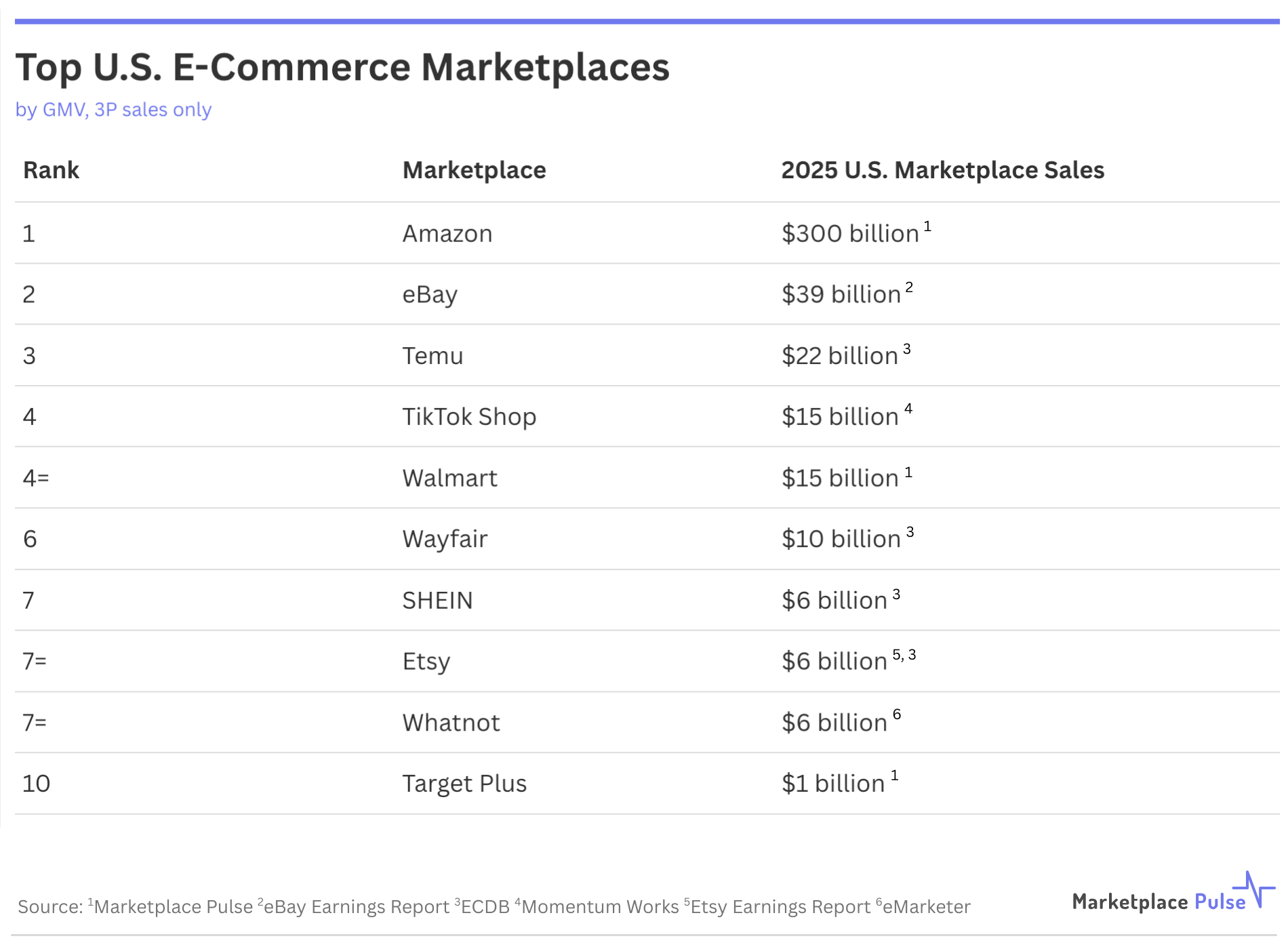
Sellers Have More Marketplace Options in 2026
The eCommerce marketplace landscape is still dominated by a few big players, but there’s plenty of variety behind them. Let’s take a closer look at the top 10 eCommerce marketplaces in the U.S.
According to Marketplace Pulse, Amazon continues to lead the pack by a huge margin, pulling in around $300 billion in third-party sales. That’s more than seven times what eBay makes and about twenty times what most other competitors do.
eBay sits in second place with roughly $39 billion in sales. The platform has shifted away from competing directly with Amazon for new products and focuses more on niche categories like collectibles, pre-loved fashion, and hobby gear.
Right behind eBay, a few marketplaces are clustering in the $15–$22 billion range. Temu is doing well at around $22 billion, moving from direct-from-China operations to a more traditional marketplace model while balancing pricing and fulfillment.
TikTok Shop and Walmart Marketplace are both around $15 billion. TikTok continues to push commerce hard despite regulatory challenges, and Walmart has expanded its marketplace, now hosting over 200,000 sellers.
Beyond the top five, several specialized marketplaces are hitting billion-dollar marks. Wayfair pulls in about $10 billion in home goods. SHEIN, Etsy, and Whatnot each do around $6 billion, serving audiences from fast fashion to handmade items to live auctions. Target Plus remains smaller, at about $1 billion, but is growing in curated marketplace transactions.
Platforms like Shopify aren’t centralized marketplaces, but their collective merchant ecosystem is huge, big enough that it competes with Amazon’s U.S. share.
For eCommerce sellers, this is good news. With so many marketplaces growing and specializing, sellers have more options to reach customers without relying on a single platform.
eCommerce
Walmart Abandons OpenAI Checkout After Low Conversions
Walmart ran a large test of OpenAI’s Instant Checkout inside Walmart’s ChatGPT integration, allowing customers to browse and buy directly from about 200,000 products without leaving the chatbot. The idea was to simplify ecommerce by letting AI handle the end‑to‑end experience.
Did the ChatGPT integration increase conversions? No. In fact, the test was a massive flop.
Purchases completed through the ChatGPT checkout converted three times lower than the equivalent experience that sends users from ChatGPT to Walmart’s own website.
While conceptually appealing, the single‑item, in‑chat purchase flow clashed with typical shopping behavior and buying patterns, weakening performance.
As a result, Walmart is stepping back from relying on OpenAI’s Instant Checkout as the transaction layer. Instead, it will embed its own AI shopping assistant, Sparky, inside ChatGPT.
Beginning late March 2026, this version will let users log in with their Walmart credentials, sync their carts, and complete orders through Walmart’s systems. A similar integration is planned for Google’s Gemini platform.
This test shows that despite the hype, AI‑led commerce still has limits when it comes to driving real sales.
Money Nomad

Looking for a side hustle?
Try Money Nomad, our sister marketplace built specifically for profitable side hustles and micro-businesses that are too small for Empire Flippers.
Check out this recent listing available on the Money Nomad Marketplace:
Listing #10064 – $100,000.00
display ads | lifestyle, home & garden
This is an established digital publishing website that is already approved and monetized through an exclusive publishing program, currently generating an average of $7,000 per month in revenue, with $6,700 in monthly average profit. The only expense is for a VA who edits and schedules the content. The site earns from platform-based distribution rather than traditional SEO, meaning you don’t need to rely on Google rankings or backlinks. Traffic is driven through a premium content ecosystem, and revenue is tied directly to views and engagement on the platform. The operation is simple and highly systemized. This is a turnkey, cash-flowing digital asset that is easy to operate and has clear room to scale for a buyer willing to expand content production. Learn More
Subscribe to the This Week in M&A Newsletter
to Get Content like This in Your Inbox Every Friday
