
This Week in M&A Issue #196
 August 4, 2025

Happy Friday!
Today’s trend of the week is “developmental baby toys”.
A soft plush toy might still be cute, but today’s parents are looking for a lot more. They want toys that help their babies learn, develop motor skills, and align with their values, especially when it comes to sustainability.
The global baby toys market, currently valued at $14 billion, is projected to exceed $19 billion by 2030. Developmental toys make up a large share of this, growing from $10.9 billion to an expected $15.6 billion by 2033.
Parents are especially drawn to toys made from natural materials like wood, recycled plastic, and organic fabrics, giving eco-friendly brands a real edge. Tech is also making its way into the nursery, with 22% of new toys in 2023 offering app-enabled or AI features. And over two-thirds of developmental toys now focus on STEM learning.
For eCommerce entrepreneurs, there’s plenty of room to grow in this playground. Whether you’re launching a line of smart, sustainable toys or creating a subscription box with curated play experiences, the market is ready. Just look at the 4.8 million families who subscribed to toy kits in 2023 alone; parents are ready for smarter play.
Today we have for you:
- Amazon abruptly pulls out of Google Shopping ads
- The rise of the million-dollar Amazon seller
And:
- Building an 8-figure autonomous business using AI agents
- AI traffic to websites grows 357% in just one year
- Amazon’s new star-only reviews spark seller concern
Alright, let’s dive in.

Image Source: Giphy (Harry Potter)
Amazon Disappears from Google Shopping Auctions, Opening Doors for Competitors
Amazon has abruptly pulled out of Google Shopping ads, disrupting digital advertising auctions and creating ripple effects across the retail and marketing world.
As of July 23, Amazon pulled out of Shopping auctions across 20 international markets, marking its first full retreat since the early days of the pandemic. Industry insiders are calling the move “colossal,” given Amazon’s long-standing dominance as one of Google’s biggest ad buyers.
For years, Amazon’s massive presence in Google Shopping helped drive up impression shares and cost-per-click (CPC) rates, often commanding more than 50% of impressions in the U.S. and U.K. But now that Amazon is out of the picture, competitors like Walmart, Target, and Home Depot are already seeing gains in visibility, some reporting a 20% increase in impression share and CPC drops of up to 40% in certain categories.
The reasons behind Amazon’s sudden exit remain unclear. Some believe it’s a cost-cutting experiment or a strategic pause between Prime Day and the back-to-school shopping season. Others see it as a test to measure the channel’s actual return on investment, or a quiet effort to stop funding a rival ad platform. Whatever the motive, the implications are big.
Whatever the reason, other brands now have a rare chance to compete more efficiently without Amazon inflating auction prices. Google account managers have already begun encouraging advertisers to seize the moment and increase budgets while CPCs remain lower.
Interestingly, some agencies report that Amazon has even disappeared from unpaid listings, suggesting a full disconnection from Google’s Merchant Center. That’s bad news for brands that relied on Amazon’s Shopping ads to drive traffic.
The big question is whether this is just a temporary pause or the start of a longer-term shift. Either way, advertisers should be watching closely and ready to move fast to capture traffic while the retail giant is sitting on the sidelines.
The Opportunity Podcast
![Building an 8-Figure Autonomous Business Using AI Agents With Amos Bar Joseph [Ep.185]-min](https://1745913.fs1.hubspotusercontent-na1.net/hubfs/1745913/Building%20an%208-Figure%20Autonomous%20Business%20Using%20AI%20Agents%20With%20Amos%20Bar%20Joseph%20%5BEp.185%5D-min.png)
Scaling to $30 Million in ARR With Just Three Founders
Traditionally, headcount equals scale. But in the age of AI, is this still true?
In this episode, we’re joined by Amos Bar Joseph, the co-founder of Swan AI, the first autonomous business. Their goal? Reaching $30 million in ARR with just three founders and a powerful fleet of AI agents.
While most companies simply bolt AI onto existing workflows to automate repetitive processes, Swan AI is designed around agentic workflows, where AI agents operate with memory, goals, and decision-making capabilities. It’s not just automation; it’s intelligent delegation.
This isn’t about replacing humans. Each agent is purpose-built to make the three founders 100x more effective by designing agents around them, rather than 1:1 replacing a hire.
Amos explains how to ensure your agents stay accurate and aligned with business objectives, avoiding ‘hallucinations’ and maintaining customer trust. He also shares when to stick with classic workflows and when to switch to agents for higher-level tasks.
If you’re interested in building a smarter, leaner business using AI, this episode will challenge how you think about scale.
Amazon
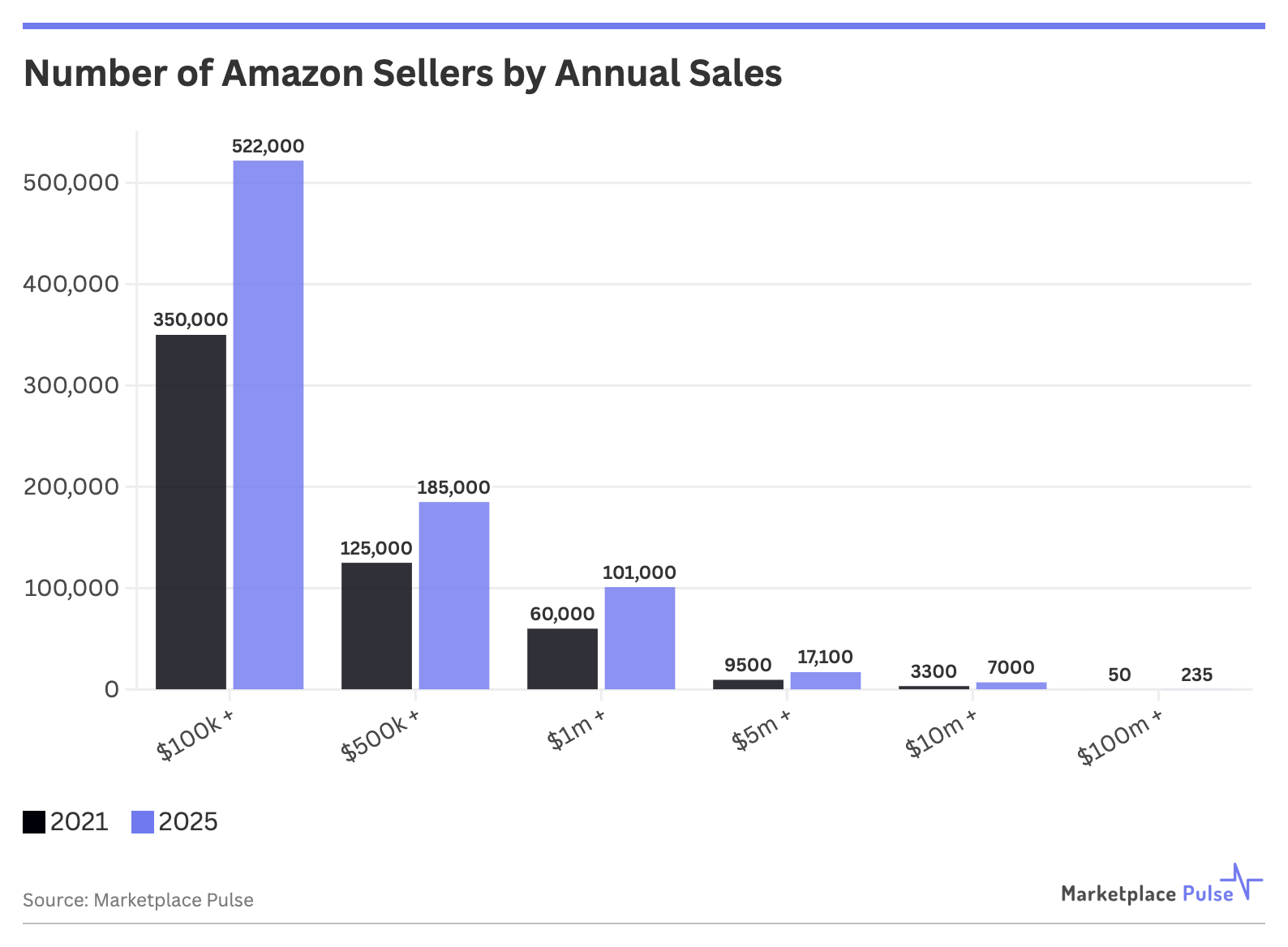
Amazon Seller Success Is Now a Game of Scale
Amazon’s seller ecosystem is becoming more competitive, and more rewarding for those who can scale.
According to new research from Marketplace Pulse, over 100,000 sellers globally now generate at least $1 million in annual revenue on Amazon, up from 60,000 in 2021. Even more notably, 230 sellers are making over $100 million per year on a single marketplace, compared to just 50 four years ago.
This growth has happened despite a 10% drop in the number of active sellers with live listings, showing a clear shift in how the marketplace operates. As lower-performing and unprofitable sellers exit, pressured by rising Amazon fees, tariff uncertainty, and tighter margins, the sellers who remain are gaining more visibility, more sales, and a larger share of total GMV.
The U.S. marketplace remains the most lucrative, with 146 of the $100 million sellers based there. Nearly 43% of all Amazon.com sellers generate $100,000 or more in annual revenue, well above the global average of 19%. Germany, the UK, and Japan follow, with around a third of sellers in each market reaching six figures.
While U.S.-based businesses dominate the top revenue tier, Chinese sellers are growing their share quickly. At the $1 million mark on Amazon.com, 57% of sellers are based in China, compared to 39% in the U.S., a clear sign of China’s increasing influence on the platform.
Marketplace Pulse highlights that this growing revenue concentration is consistent with the Power Law in marketplaces: a small percentage of sellers are responsible for the majority of sales. In fact, just 2% of U.S. sellers now generate over half of all Amazon.com revenue. At the same time, traffic per seller has increased by 31% since 2021, meaning less competition for customer attention – if you’re in the top tier.
For Amazon sellers, the takeaway is clear: while it’s getting harder to succeed without scale, the potential rewards for those who adapt, by optimizing operations, expanding product lines, and managing margins effectively, have never been greater.
Read All About It!
🧮 Simple SEO traffic estimator: plus growth strategies for 2025
✍️ 150+ AI prompts to automate & scale: work smarter, not harder
🌐 Best free website builders: how to choose the right one
🔐 How to secure your business name in 5 simple steps: protect your brand
Web Traffic
ChatGPT Leads Massive Rise in Ai-Driven Web Traffic
AI platforms like ChatGPT are rapidly becoming a major source of website traffic.
In June 2025, AI-driven referrals to the world’s top 1,000 websites hit 1.13 billion, an increase of 357% compared to June 2024, according to data from Similarweb. While that’s still far behind Google Search, which generated 191 billion referrals in the same month, AI is growing quickly as a new way people discover content online.
The biggest impact so far has been on news and media websites. AI referrals to news sites grew 770% year-over-year. In June 2025, Yahoo led with 2.3 million visits from AI platforms, followed by Yahoo Japan, Reuters, The Guardian, India Times, and Business Insider. Some publishers like The New York Times, which block AI bots due to legal concerns, are missing out on this traffic entirely.
ChatGPT dominates AI referrals, responsible for over 80% of visits from AI platforms to top websites. Other platforms contributing to the traffic include Google’s Gemini, Claude, Perplexity, and Grok.
AI-driven traffic isn’t limited to news. In eCommerce, Amazon received 4.5 million AI referrals in June, followed by Etsy (2.0M) and eBay (1.8M). In tech and social media, Google led with 53.1 million referrals, ahead of Reddit, Facebook, GitHub, and Microsoft.
Across other categories, the top sites by AI traffic included YouTube (31.2M), Wikipedia (10.8M), NIH.gov (5.2M), and Zillow (776K).
While users are happy to click on links in AI platforms, they are far less receptive to AI suggestions in search. A recent Pew Research study found that when Google shows AI Overviews in search results, users click on links just 8% of the time. When no AI summary appears, the click-through rate jumps to 15%. This change is already hurting traffic to many publishers, especially those that allow AI tools to access their content.
As AI tools increasingly shape how people find and access information, businesses that want to stay visible online will need to adapt, not just for Google Search, but for AI platforms as well.
Amazon
Amazon’s New Star-Only Feedback System Raises Seller Concerns
Starting August 4, 2025, Amazon will allow customers to leave star ratings for sellers without written comments. The company says this change will simplify the feedback process and lead to more customer participation.
However, the change has sparked widespread concern among sellers who fear it will harm their businesses and reduce the quality of feedback on the platform.
Previously, customers were required to include a written explanation alongside their star rating. Sellers relied on these comments to understand and address specific issues, such as delays, packaging problems, or confusion between product and seller performance. With text now optional, that crucial context will be missing, leaving sellers guessing about the reason behind low ratings.
What’s more, Amazon is disabling the ability to appeal star-only ratings in its Feedback Manager. Instead, sellers must report potential violations through a more limited “Report a violation” tool, which offers fewer chances of having inaccurate ratings removed. Sellers say this is especially damaging when negative feedback relates to Amazon’s Fulfillment by Amazon (FBA) service, issues they have no control over but are often blamed for.
Many fear that star-only ratings will also worsen the long-standing confusion between product reviews and seller feedback. Without written content, it becomes nearly impossible to determine whether a rating reflects the seller’s performance or a customer’s opinion of the product.
This change directly affects key metrics like Order Defect Rate and Buy Box eligibility, both of which influence a seller’s visibility and sales potential. Sellers warn that even a few unfair star-only ratings could jeopardize their account health.
As the change approaches, many are calling on Amazon to retain appeal rights, improve customer education, and require comments for low-star feedback to ensure accountability remains part of the system.
Subscribe to the This Week in M&A Newsletter
to Get Content like This in Your Inbox Every Friday
